My good friend Liz has a recurring books of Senegal post on her blog. As I recently finished my 100th book in this country, I figured this was a good time to shamelessly copy her idea. Enjoy!
1. Aaron, Chester. Garlic is Life
a. Read if you want to hear a garlic snob wax poetic about subtle bouquets of delicate flavors in different varieties of garlic
b. The 25 CFA boutique garlic is fine by me
c. Is there anyone named Chester who is not pretentious?
2. Adiga, Aravind. The White Tiger
a. An indian man goes crazy, kills his employer, and becomes an entrepreneur
b. The story is told through letters said crazy man writes to a stranger (the President, if I remember right.)
c. Not terrible, but not worth your time to read. There are many better books.
3. Albom, Mitch. The Five People You Meet in Heaven
a. My college roommate Sam read this and said it was good. I've had it on my mental "to-read" list for the last six years.
b. It was good.
c. If there is a heaven, I hope to meet thousands of people there, not just five.
4. Alford, Henry. How to Live.
a. Alford asked old people for their accumulated life wisdom and advice, sorted it, and put it in a book that is entertaining and wise without being preachy or fatalistic.
b. I think I’m doing OK at life.
c. Grandma Michel is the best old person and if I end up half as amazing as her I’ll be delighted.
5. Ambrose, Stephen E. Undaunted Courage
a. Lewis and Clark travel across America
b. Indians save their asses many, many times
c. Sacagawea’s a badass bitch
6. Atwood, Margaret. The Blind Assassin.
a. Beautiful story beautifully told.
b. Probably my favorite Atwood book.
c. "Farewells can be shattering, but returns are surely worse. Solid flesh can never live up to the bright shadow cast by its absence. Time and distance blur the edges; then suddenly the beloved has arrived, and it's noon with its merciless light, and every spot and pore and wrinkle and bristle stands clear."
d. That quote perfectly sums up why it’s scary to return home after Peace Corps.
e. Five stars.
7. Austen, Jane. Pride and Prejudice
a. I wish the main characters would just talk about their feelings like grown-ups
b. Cute, but I’m still not a card-carrying Austen fan.
8. Ba, Mariama. Scarlet Song
a. A cautionary tale of a failed forbidden romance between two Dakar university students, one French and one Senegalese
b. Made me aware of even more reasons I’m absolutely not interested in Senegalese men
c. Fast-paced and interesting, with very accurate descriptions of people and customs here.
d. Five stars.
9. Bishop, Holley. Robbing the Bees
a. A history of beekeeping and honey production
b. Not as good as I would expect, because usually well-researched science journalism is my jam.
c. Three stars.
10. Brown, Dan. The Da Vinci Code
a. I can sort of see what all the hype was about a few years ago when all the copies of this were flying off the supermarket shelves.
b. I don’t necessarily think we should blame the Catholic Church for keeping women down.
c. But hey, let’s let bygones be bygones and make women equal in all ways already. #leanin
11. Brown-Waite, Eve. First Comes Love, Then Comes Malaria
a. A woman starts dating her Peace Corps recruiter, ET’s, then marries him and moves to Africa to be a housewife when he gets a job with a non-profit.
b. I thought it was cute, but the friends I recommended it to hated her.
c. I concede that perhaps there are stronger female role models out there.
12. Bryson, Bill. A Walk in the Woods
a. Bill Bryson decides to walk the entire Appalachian trail.
b. Spoiler alert – he didn’t finish.
c. Still funny and well-written. I would love to have dinner with the Brysons, they seem delightful.
13. Bryson, Bill. I’m a Stranger Here Myself.
a. Essays on returning to America after 20 years away.
b. Some were good, some were OK.
c. America’s pretty great.
d. Okay, but not the best Bryson book you could read.
e. The best Bryson book you could read is A Short History of Nearly Everything.
14. Bunch, Roland. Two Ears of Corn
a. A guide to sustainable agriculture development work
b. Very, very relevant to my time here
c. A must-read for PCVs.
15. Cadbury, Deborah. The Dinosaur Hunters
a. Started promisingly, about early eccentric fossil hunters, but then became a boring law story about who owns what where when.
16. Chabon, Michael. The Amazing Adventures of Kavalier and Clay
a. Comic book writers in New York in the 1950s
b. Cute and well-done.
c. Only one female character, and the only interesting thing she did was get pregnant.
17. Colbert, Stephen. I am America and So Can You.
a. Silly fun.
b. Lots of pictures.
c. I don’t know if it qualifies as a book.
d. I need it to get to 100, it’s a book.
18. Coyne, John. Living on the Edge
a. A short story collection of Peace Corps writers.
b. I favored the stories from Africa, but could relate to all.
c. We Peace Corps writers are a fun bunch. I should probably write more about my crazy life here.
19. Desowitz, Robert. The Malaria Capers
a. This is oddly named. I would not call it "caper." It is mostly hard science about malaria.
b. Did you know that human malaria transmission was figured out by studying sparrow malaria?
c. Many species have a malaria specific to them.
d. Fascinating.
e. I read this whole damn thing while stuck at the Gambia river crossing for 12 hours when the ferry was broken.
20. Ebershoff, David. The 19th Wife
a. Morman polygamists.
b. Weird blend of vaguely accurate history, completely fabricated history, and completely fabricated present-day events.
c. Followed the lives of about ten characters and I only liked one of them. Jordan, ICYWW
21. Eggers, Dave. A Heartbreaking Work Of Staggering Genius
a. A boring work of overinflated drivel. Two stars.
b. Man’s parents die so he raises his brother. They eat pizza and verbally spar together like a bad movie.
22. Erdman, Sarah. Nine Hills to Nambonkana
a. A Peace Corps memoir.
b. Bitch helped with a village birth before going back to IST
c. Bitch spoke fluent French, and so did all her coworkers, so there were no language barriers
d. Bitch had effortlessly successful projects and integrated seamlessly with her host family
e. This bitch is jealous of that bitch.
23. Fadiman, Anne. The Spirit Catches You and You Fall Down
a. A Hmong family and their American doctors disagree about the best course of treatment for a little girl with epilepsy.
b. Very well written, one of my favorite books ever. Handled with great cultural sensitivity.
c. Made me wonder what traditional Pulaar medicinal beliefs are and how I’m stomping all over them by promoting western beliefs instead.
d. Highly recommended for anyone working with a foreign culture.
e. Five stars.
24. Fiffer, Steve. Tyrannosaurus Sue
a. Mostly about legal battles over who owns Sue, the famous T Rex discovered in South Dakota.
b. The only legal battles I love are the dramatic 5 minute courtroom blowouts at the end of SVU episodes.
c. I do not recommend this book.
25. Flynn, Gillian. Gone Girl
a. Made me literally shout "holy shit!" at the twist in the middle.
b. Five stars.
26. Folett, Ken. Fall of Giants
a. Beware : it is a series, so nothing gets resolved at the end of the hefty 1000 pages.
b. Folett is very good at introducing then killing off or sending away characters, so there’s always a lot of action.
c. I don’t think I actually learned about World War One, which is why I decided to read this.
27. French, Tana. In the Woods
a. A detective duo solves the case of a murdered girl.
b. Loved the story, ambivalent towards the ending. I would read the rest of the series if I were to find them at regional houses but I would not seek them out.
c. Psychopaths are terrifying.
d. I think I once dated a psychopath.
28. Friedman, Thomas. Hot, Flat, and Crowded
a. Western lifestyles are killing everything.
b. The Pulaar village lifestyle, growing food and then eating it, is certainly more sustainable
c. But I wouldn’t want to be here forever.
29. Gately, Iain. Tobacco
a. Made me want to start smoking. Tobacco has such a rich, fascinating history.
b. Don’t worry, I won’t actually start smoking.
30. Gilbert, Elizabeth. Eat, Pray, Love
a. I was on board with "Eat", then "Pray" was bad, and by the time I got to "Love" it was hard to keep reading because I couldn’t stop rolling my eyes
b. "Soft, buttery kisses that taste like soft, buttery potatoes."
c. Gag me with a spoon.
d. It is an unlikeable trait to prattle on about how much everyone that meets you likes you.
e. She bought a $40,000 house for a woman she’d only known three months.
f. That’s not kindness, that’s madness. I hope there are no development workers in Bali dealing with the gimme-gimme aftereffects of that.
g. She said she was at peace being single and that men only complicated her existence, then slept with one the next night. Way to take a stand, Liz!
h. Totally overhyped. A hate-read.
31. Gladwell, Malcolm. Outliers
a. The only thing that matters for success is that 1) you practice something enough to get real, real good at it, and then 2) a market demand arises for people that are real, real good at that thing.
b. If you practice something for two solid hours, every single day, no exceptions, it would take you about fifteen years to be an expert.
c. I don’t think I’ve put 10,000 hours into anything exceptional.
d. Maybe that’s why I don’t have many marketable skills.
32. Goldberg, Myla. Bee Season.
a. I liked the beginning a lot, when it was just about spelling, but shit got weird with Hare Krishnas and kleptomania. Still a good read, but I’d like it more if it were cuter and lighter.
b. A must read if you like Hare Krishnas and kleptomania
33. Green, John. The Fault In Our Stars
a. Quick read; I got through it in one village day
b. Did tend to use big words seemingly just for the pretentious sake of doing so.
c. Very cute story that lent itself perfectly to a very cute movie.
34. Green, Toby. Meeting the Invisible Man: Secrets and Magic in West Africa
a. A guy spends tons of money on gris-gris (traditional charms used to ward off evil), then claims that they actually work somewhat well.
b. Eye-roll inducing.
c. I don’t believe in magic in any country.
d. Killing a cat to use its hair in gris-gris is cruel.
e. Several months ago a Senegalese person offered to pay my red-haired friend exorbitant sums of money for strands of her pubic hair to use in gris-gris.
f. I’m OK with ginger PCVs using their genetic recessiveness as a salary supplement.
35. Heath, Chip and Dan. Switch
a. Behavior change is hard.
b. I wonder if people would wash their hands in village if they all had western-style porcelain bathroom setups.
37. Hochschild, Adam. King Leopold's Ghost.
a. The true story of belgians fucking up the Congo
b. Good/bad story to read in Africa. A downer, but a very important downer. Made me feel more globally aware.
c. Five stars.
38. Holmes, Hannah. The Secret Life of Dust
a. Do you know what dust is made out of?
b. I don’t remember. But the book explains it, and it’s interesting!
c. Five stars.
39. Huchu, Tendai. The Hairdresser of Harare
a. A swaggy rich man becomes the new hairdresser at a salon in Harare, Zimbabwe, and strikes up a weird "are we friends or more than that" relationship with another hairdresser.
b. Spoiler: They’re just friends. Because he’s gay.
c. He’s a hairdresser.
d. Of course he’s gay.
e. This is for some reason a huge bombshell.
40. Kaysen, Susanna. Girl, Interrupted.
a. Made me want to watch the movie
b. Made me want to spend some time in an institution, just because it sounds fascinating.
c. How do you know if you’re crazy?
41. Kingsolver, Barbara. Animal Dreams.
a. A woman returns to her hometown to work as a teacher and figure her life out.
b. Loyd Peregrina is my biggest literary crush since Marco from Animorphs.
c. Five stars.
42. Kingsolver, Barbara. Flight Behavior
a. Monarchs are nesting in Appalachia instead of in Mexico.
b. I loved every character. Kingsolver is real good at creating people that you feel like you’re hanging out with.
c. Five stars.
43. Kingsolver, Barbara. Pigs in Heaven
a. A sequel to "The Bean Trees"
b. I like the first book better after reading this one. It straightens out legal difficulties Taylor’s clandestine adoption doubtless would have brought on.
c. I was satisfied by how neatly and cleanly everything got tied up at the end.
44. Kingsolver, Barbara. Prodigal Summer.
a. Three interweaving stories of love and family, set in Appalachia.
b. Deanna reminded me of me.
c. I was narcissistic enough to enjoy this immensely.
d. I wish I would have written this. Five Stars.
e. This book told me that when exposed to enough natural moonlight, women will start to cycle with the moon, so they’re ovulating during the full moon.
f. An informal survey of female PCVs showed that most of us do not.
g. I do.
45. Kingsolver, Barbara. The Bean Tree
a. White girl unintentionally kidnaps Indian child, names her Turtle, keeps her, loves her.
b. I wish I could do that with 85% of the kids in my village.
46. Kingsolver, Barbara. The Poisonwood Bible
a. A very good book.
b. A missionary family with four kids moves to the Congo. Each chapter is told from the point of view of a different character. Each character is believably, fallibly human, with flawed, authentic personalities.
c. Inspired me to text a friend only in anagrams for awhile.
d. We have a lot of free time here.
47. Kirino, Natsuo. Out
a. Japanese woman commits Murder Most Foul, asks coworkers at the box lunch factory to help her cover it up
b. I liked two of the women, hated one, and revered one as a personal hero. Read it and try to choose which is which.
c. Four stars.
48. Klosterman, Chuck. Killing Yourself to Live.
a. Chuck Klosterman has a high opinion of himself.
b. It was good but not as good as Chuck Klosterman probably thinks it is.
49. Kolata, Gina. Rethinking Thin
a. A claim that diets don’t work.
b. I claim that healthy lifestyles do work (ie, lead to permanent weight loss).
c. If you want to lose weight start walking/kayaking/biking/skiing/rock climbing/playing outside.
d. #workedforme
50. Kurlansky, Mark. Cod: A Biography of the Fish that Changed the World
a. Five stars.
b. Cod are fucking fascinating.
51. Lamb, Wally. I Know This Much is True
a. A man tries to come to terms with his twin brother’s schizophrenia.
b. Five stars.
52. Lamb, Wally. She's Come Undone
a. Girl deals with a troubled past by stress-eating, lying, acting out, and being a terrible person. Gets mental help. Loses weight. Continues being a terrible person until she figures some stuff out.
b. Very good, but also my least favorite Wally Lamb book.
53. Lamb, Wally. We Are Water
a. One of those books you stay up reading until 4am just to see what happens
b. Wonderfully developed characters.
c. Full of rape, incest, traumatic experiences, and pain...will make you feel some feelings.
d. Five stars.
54. Lee, Chang-rae. Aloft.
a. A middle-aged man struggles to figure his life out. He has kids and they’re also figuring their lives out. One of those stories where the plot itself is sorta mundane but told so well that you love it anyway.
55. Lee, Chang-rae. Native Speaker
a. Gave me a qualifier I now use to describe myself, "B+ student of life. "
b. I wanted to hug all of the emotionally fragile men in this story.
c. Beautifully written.
56. Levi, Primo. The Periodic Table
a. This book was a gift from Mark M when I was home for vacation.
b. Short stories written by a chemist, each inspired or involving a different element.
c. My favorite element is carbon.
d. This is not related to the book, just a fun fact.
57. Maguire, Gregory. Wicked
a. You’ve probably seen the play. I haven’t, so I thought the story was interesting, original, and engrossing.
b. I wanna hug ephelba.
58. Margulis, Lynn. Symbiotic Planet
a. Did you know she was married to Carl Sagan for awhile?
b. Why did she tell me about him and other lovers in what I thought was a science book?
c. Oddly, bafflingly personal. Two stars.
59. Martel, Yann. Life of Pi
a. Boy travels in boat with tiger.
b. Detailed descriptions of what it’s like to poo after months of dehydration and starvation.
c. Somehow beautiful story anyway. Five stars.
d. I thought the ending was invocative and original. I have heard hateful reviews of the ending. Read it and tell me what you think.
60. Martin, George R.R. Storm of Swords
61. Martin, George RR. A Dance with Dragons.
62. Martin, George RR. Feast for Crows
63. Martin, George RR. Game of Thrones
a. Lives up to the hype.
b. Well-rounded and developed characters that are believable and demand respect, even if they’re unlikeable.
c. I think most of the changes the show made were for the better.
d. I haven't read A Clash of Kings because I haven't been able to find it at any regional houses.
e. My friends say it's the worst book anyway, too Stannis-heavy.
64. Max, Tucker. Assholes Finish First.
a. Skeevy man tells skeevy stories about doing skeevy things with his skeevy friends
b. It certainly seems like Mr. Max is enjoying his life, I’ll give him that
65. Meyer, Kathleen. How to Shit in the Woods.
a. BURY it, for pete’s sakes.
b. This book taught me that traditional female vs. male garb was probably traditionally chosen based on ease of urination in different garments.
c. I confirm: it’s easier to pee in a skirt than pants.
66. Miller, Alan. Gaia Connections
a. This book was published in the 1960s and hard to get through. Very hippy-ish.
67. Moalem, Sharon. Survival of the Sickest
a. Being heterozygous for many genetic traits is good, but homozygous can kill you.
b. Two copies of sickle cell = sickle cell disease = likely death. One copy = your blood cells are completely functional, but also you can’t get malaria = likely survival = gene stays in the population.
c. Several other examples of this.
d. Fascinating.
e. Five stars.
68. Montgomery, David. King of Fish: The Thousand-Year Run of Salmon.
a. Man finds resource. Man overexploits resource. Resource runs out. Man is indignant.
b. Interesting read. I wish the planet had fewer humans to muck stuff up.
69. Munro, Alice. The View from Castle Rock.
a. Fabricated stories loosely based on truth.
b. Not good enough to be worth your time as fiction – not true enough to be valuable as non-fiction.
c. Two stars.
70. Murray, John. A Few Short Notes on Tropical Butterflies
a. A short story collection. I usually don’t like short stories, but every one of these was gorgeously written, in the type of way that you just sigh, relax, and mentally swim through the pages. Beautiful. Five stars.
b. I don’t recall there actually being anything about butterflies in the book.
71. Niffenegger, Audrey. The Time Traveler's Wife
a. A man sometimes travels through time. He can’t control where or when he ends up, and he can’t control when he takes his trips. A lot of times he visits his future wife throughout her girlhood (before they "meet"). It is a silly concept, but not a silly book.
b. Hauntingly beautiful. The kind of book you think about for weeks after finishing it.
c. Five stars.
d. I did not care for the movie. I don't think this book could ever make a good movie.
72. Palahniuk, Chuck. Choke
a. I don’t care for Palahniuk.
b. I suppose if you like him this is pretty standard writing by him.
73. Pollan, Michael. Second Nature: A Gardener's Education
a. I don’t remember reading this. Take that for what it’s worth.
74. Priven, Joshua. The Worst-Case Scenario Survival Handbook
a. I have forgotten everything in here since reading it.
b. But I’ve been surviving pretty well anyway
c. #crushinit
75. Rachman, Tom. The Imperfectionists
a. A bunch of overlapping stories of people that work together in a Rome newspaper.
b. I remember I liked it, but I honestly don’t remember any other details.
c. So, clearly, it was enjoyable but forgettable.
76. Rand, Ayn. Atlas Shrugged
a. I’m slightly ashamed to admit how much I loved this. I wish it were just a story, not a political allegory.
b. But I skipped the 40 page John Galt rant. Jesus Christ, Rand, hold it in a bit.
77. Rivoli, Pietra. The Travels of a T-Shirt in the Global Economy
a. An economics professor traces the life of a Florida souvenir t-shirt she got at a big box store.
b. Lots of technical talk about economics, subsidies, global trade, written easily enough that a novice like me could understand it.
c. Interesting.
d. Maybe without subsidies my Senegalese host family could sell their cotton for more money
e. Maybe without subsidies cotton clothing would be crazy expensive.
f. IDK.
78. Roach, Mary. Packing for Mars
a. A true story about past and potential future space travel.
b. Lots of poop jokes.
c. Silly, well-researched, scientifically accurate fun.
d. Five stars.
79. Robbins, Tom. Jitterbug Perfume
a. Every sentence was poetry.
b. Weird and wonderful.
c. I want to read everything else he’s written but so far the regional house library gods have not answered that prayer.
80. Rowling, JK. The Casual Vacancy
a. It’s weird that Rowling wrote a book with so much profanity
b. I cried at the end.
c. Five stars.
d. Apparently they made a BBC miniseries about it, it's on my to-watch list when I return to America unemployed with ample free time and abundant internet.
81. Sandberg, Sheryl. Lean In
a. Did you know that men apply for jobs if they have 60% of the qualifications, but women tend not to apply unless they have 100%?
b. Change the world! Men as partners! Reach for the stars! Lean in! Get it, girls!
c. Just after finishing the book, I heard Ms. Sandberg’s wonderfully supportive husband died recently in a freak treadmill accident. I almost cried.
82. Sedaris, David. Dress your Family in Corduroy and Denim
83. Sedaris, David. When You Are Engulfed in Flames
84. Sedaris, David. Naked
a. David Sedaris is delightful.
b. He somehow makes common things sound fascinating and exciting.
c. I would like David Sedaris to narrate my life.
85. Shaffer, Mary Ann. The Guernsey Literary and Sweet Potato Pie Society
a. Adorable. The fluffy white baby bunny of novels. I recommend this to anyone, no reservations. It’s an overload of cute.
b. Neighbors bond together over a book club. The novel is written entirely in the form of letters they send to each other.
86. Shah, Sonia. The Fever
a. A history of malaria and discussion of why it’s so hard to stop worldwide
b. Occasional segments were grossly untrue to my experience here
c. Overall very informative. Read it, then call me so we can talk about it more.
87. Shteyngart, Gary. Super Sad True Love Story
a. A weird futuristic older man/young Korean girl relationship is the love story in question
b. It was sad, but not super sad, and definitely not true.
c. False advertising.
88. Stein, Garth. The Art of Racing in the Rain
a. A dog/human companionship story told from the point of view of the dog.
b. Did you know when dogs shit all over the rug they’re doing so purposefully and vindictively, because you or your girlfriend has wronged them?
c. I want a dog despite this.
89. Stephenson, Neal. Anathem
a. This story is only about 80% English, the rest is made-up vocabulary and concepts.
b. Made me feel like I’m not even fluent in English, there’s no hope for my Pulaar.
90. Stephenson, Neal. Cryptonomicon
a. About codebreakers, both human and machine.
b. Every character in this book is smarter than me.
c. Except the one token woman, who is of normal intelligence.
d. I disliked this.
91. Stephenson, Neal. Snow Crash
a. Hackers and computers and futuristic skateboard girls
b. Skateboarding tethered to the back of semi-trucks sounds fun.
92. Stevens, Stuart. Malaria Dreams
a. Delightful story of trying to drive a car from the Congo to Egypt.
b. I’m thankful I don’t have a car here.
c. Mechanical skills would be far more valuable in a PCV than any attribute I bring to the table.
93. Stokes, Penelope. Circle of Grace
a. A supermarket ‘mom book,’ mindless but cute.
b. Minimal character development
94. Styron, William. Sophie's Choice
a. Two stars.
b. I think the movie was probably better because it was edited.
c. I wish the book would have been edited.
95. Taylor, Justin. The Apocalypse Reader
a. The worst thing I have read in this country.
b. I read it early on, when I was trying to not quit any books.
c. Since reading this I have quit roughly ten books that were all better than this one.
d. One star.
96-98. Tolstoy, Leo. War and Peace.
a. Tolstoy said War and Peace was three books, so I do too.
b. I don’t care if this is cheating.
c. It’s motherfucking War and Peace
d. It was a bitch to get through, I earned it.
99. Truss, Lynne. Eats, Shoots & Leaves.
a. The title of this one is hard to write as it's intended because I love the oxford comma.
b. I tend to overuse commas in general.
c. Ms. Truss says this is not incorrect, merely annoying.
d. I’ll probably keep doing it.
100. Walls, Jeannette. The Glass Castle
a. A memoir of growing up with vagabond parents.
b. Made me feel some feelings.
c. Amazing story. A must-read. Five stars.
Saturday, October 31, 2015

Sunday, September 27, 2015
A picture's worth 1,000 words...
...but unfortunately the Senegalese electronics assassin team of Heat, Humidity, Power Surges, and Sandy Dust killed my camera and my smartphone in the last month, so words are the only tools I have left at my disposal.
Oh well.
This quote is beautiful and relevant:
Oh well.
This quote is beautiful and relevant:
For none of us can ever express the exact measure of his needs or his thoughts or his sorrows, and human speech is like a cracked kettle on which we tap crude rhythms for bears to dance to, while we long to make music that will melt the stars. ~Gustave Flaubert
I'm not aiming to melt any stars, I'm just trying to describe things here accurately...hopefully, this will do. If I still had a camera, these are the ten pictures I would have taken to sum up Teyel Tabaski 2015:
1) The severed heads of two rams, one black and one brown, eyes dark and unseeing, mouths slightly agape. Proud curved horns curl around the heads; on the right ram, the black one, they nearly touch the ground, indicating that he was probably the primary sacrifice this morning. The left ram, the brown one with shorter horns, is tilted to one side, balancing on a horn, a soft string of spongy pink brain stem protruding from the nape of his neck. There's a ruddy smear of blood on his floppy brown ear. The black ram's head, in contrast, is clean and sitting straight-up, as though he's merely resting, dignified, the rest of his body hiding under the sand. A skinny rooster is eying the heads cautiously, weighing his options, trying to figure out whether they're edible.
2) My beautiful host sisters Fatou and Medo laughing at something the baby did. They've got three and four packets of fake weave hair in, respectively, and each is wearing it in a high ponytail held in place with a thick black cable normally used to tie luggage down on a bike rack, a feat of engineering necessary because the bulk of the hair broke 3 of my ponytail holders as I was attempting to restrain it. They're wearing matching light brown complets, in the style popular with teenagers here, fitted on top with a huge peplum just above their hips, and its shocking how mature they look. Last Tabaski, at 12, they were girls, and somehow this year at 13 they suddenly look like women.
3) A troop of young girls (toddler - 8ish), led by a confident, muscular, immaculately braided troublemaker who's toddling on white jeweled high heels. The leader's pitching to the side because the heels are ludicrously impractical here and keep getting caught in the sand. All the girls are wearing matching skirt and shirt outfits, walking from compound to compound to demand salibo. Salibo is like Senegalese trick or treating; most families set aside a small stash of coins or candy for visiting neighbor kids, who then return home from their afternoon of scavenging with full pockets and sugar headaches. In Teyel, salibo is the day after Tabaski, and the girls know that perfectly well, but if they ask enough people who are in happy food comas after the feast, maybe they'll get something.
4) Baby Mariama, formaly braided with fake hair for the first time. The job is sloppy and obviously rushed, testament to the fact that Mariama vehemently disagreed to the braiding process and had required two girls to hold her in place while another plaited her as quickly as she could. At almost two, Mariama is barely recognizable as the infant she was last Tabaski.
5) An enthusiastic selfie with my 16ish year old host sister, Hawa. I would most likely look insane in the picture, she bewildered and amused, but unshakably calm. Hawa lives in Kounkane, a town about 15k away, doing housework for a relative, but she came home for Tabaski. Hawa is sweet, sassy, and funny, far cooler than me, and I adore her, though I very rarely get to see her. Unfortunately, since she has zero years of formal education, her current "cook, sweep, and wash for the men" routine will probably be continued for the rest of her life.
6) My gorgeous baby tokara, 16 months old now, face scrunched up in tears. She's reached the unfortunate age babies pass through where they realize I don't look like a normal human, but they don't yet realize I'm OK. Hopefully she'll pass through it soon; it's a blow to the self-esteem to have a baby bust out crying when she looks at your face, particularly one who I have visited several times a week for a year and a half. Even crying, baby Kadiatou is beautiful, all chubby cheeks and tiny rosebud lips. She has a fancy pink scrunchie precariously balanced around a tuft of poofy hair too short to properly hold it.
7) A circle of neighbor kids dancing the hokey-pokey. I translated the lyrics to Pulaar on a whim one day and it really took off. If I make no other difference in this village, at least I taught Teyelans a fun new game that will confuse the hell out of future anthropological researchers. A few of the girls have torn strips of black plastic bags tied around their fingers; they're waiting for their henna to set.
Wad junngo ñaamo to ndeer
Wad junngo ñaamo to yaas
Wad junngo ñaamo to ndeer
Dimmbu dimmbu dum comme ça
A waadat hokey pokey
A werloto hoore ma
A amat haa abadan
|
Put your ‘eating hand’ inside
Put your ‘eating hand’ out
Put your ‘eating hand’ inside
Shake it shake it “like this” (comme ça is French but most people get
it).
You will do the hokey pokey
You will turn yourself
You will dance forever.
|
8) My host sister and namesake, Kadiatou, closing her eyes and smiling while working through a chewy piece of ram intestine. Every part of the sacrificed Tabaski ram is eaten - liver, intestines, windpipe, even the testicles. Though I deeply respect the lack of waste, my taste buds are not so rational and very little of the meat here is delicious to me. I suppose my host family would probably be equally unimpressed with sauerkraut or lutefisk.
9) My crazy little trash kitten, Mallory, when I gave her a ram knee to gnaw on. She was trying to eat it as quickly as possible while also spinning around in a lookout to make sure no bullying chickens were coming to wrestle it away from her, and making a primitive purr-yelp-moan that I'm pretty sure meant "this is the best day of my life."
10) I would also take (but probably not share) a picture of myself as I looked when I formally stepped out to greet the village. My vil loves it when I wear makeup (probably because I do it so infrequently), and they love it even more when I forgo the subtle enhancements I find pretty and instead paint my face with the brightest, most garish colors I can find. I therefore had enough eye shadow to shame Mimi from the Drew Carey show, my lips were clown red, and I had an unnatural pink shade of blush in a thick stripe down each cheek. According to the ladies of Teyel, it was ravishing. If you could divert your attention from my mess of a face, you'd have noticed that my hair was equally ridiculous, braided thick with fake hair in a bold blend of browns, reds, and purples. It was a running joke with my Peace Corps friends that I should dress up formal-Senegal style for my sister's wedding in April, but I think if I'd have actually done so, she would have strangled me.
So, there you have it. Seeing a picture is not the same as being here; reading words is not the same as seeing a picture. Still, it's the best I could do right now. Happy Tabaski!
So, there you have it. Seeing a picture is not the same as being here; reading words is not the same as seeing a picture. Still, it's the best I could do right now. Happy Tabaski!
Saturday, August 22, 2015
English Camp in Thies
I'm writing this while sipping iced café au lait on a shaded restaurant patio in sunny beautiful Thies. I left site and came up here to help with a weeklong English camp at Lycee Malick Sy, a local high school. The camp ended yesterday, so my plan was to wake up early, pack up my stuff, corral my new garbage kitten Mallory, say goodbye to my dear friend Liz, and be to the garage early enough for Mallory and I to get the just-after-sunrise car to Tamba.
That plan did not happen.
There are absolutely no consequences for that plan not happening.
Peace Corps work is notoriously nebulous and hard to define. I do not have a formal work supervisor in village, and the counterparts I do work with often only agree to help me because I dog them so aggressively. The "work" I had to get back to village for was self-assigned and will still be there upon my return tomorrow. To assuage my lingering guilt, however, I decided to write a blog about my week. You are now reading that blog. Thanks.
So, how did camp go? Well, I don't know. I think the kids had fun, but I don't know how much English they learned. When I get blank stares in response to things I say in village, I usually assume my baby Pulaar is to blame. This week, however, I got a similar number of blank stares while speaking my native tongue, as slowly and simply as I was able to. Kids were largely unable to follow simple commands like "make a circle" or "stand in line," but they correctly spelled "decision" and "mythical" during the spelling bee, and knew "octopus" and "antelope" when confronted with badly drawn pictures of them. It was baffling.
So the campers and I didn't really speak the same language, and we also didn't really have the same definition of what the camp should be. Since it was only a half-day, from 9-1, with a half-hour break in the middle, Liz and I were trying to get the most out of every short minute. I've happily embraced "Africa time" in village, but this was not village - this was a formally scheduled city camp, with students chosen for their academic potential, with set start and end times. It was frustrating trying to compromise between a slow, viscous Senegalese culture and a tight, rigid American one. Even though the campers did, miraculously, all arrive at 9, when the camp was scheduled to start, it took at least 15 minutes to get the first activity underway, and all subsequent activities also required several long minutes for the campers to slowly transition, as though all their movements were done in a vat of honey.
Our Senegalese co-facilitators were wonderfully encouraging, perhaps to a fault. A typical interaction went like this:
"Should we do the vocabulary game or the fill the bottle race next?"
"Yes!"
"Which one?"
"Whatever you want!"
"OK, how about vocabulary?"
"Yes! That's OK!"
"Is inside or outside better?"
"Yes! Whatever you want!"
"Outside there is more room."
"Yes! Outside!"
"But it looks like it might rain."
"Yes! Whatever you want! It is OK!"
Eventually we just started leading the sessions on our own, which was fine, but not ideal because we didn't really know what we were doing or what the students' English abilities were, so we didn't know how hard the activities should be.
By the end of the week, we had it mostly figured out. In case future English Camp teachers happen to be reading this, here are the week's most and least successful components. Read and learn, because by camp time next year this girl's gonna be sippin' sangrias stateside and won't be around to help, suckas.
MOST SUCCESSFUL:


 |
| Mallory the garbage kitten is very studious and very adorable. She's my hail Mary to take down my hut rat. I have no idea how she was a street cat; she's the friendliest kitten ever. |
There are absolutely no consequences for that plan not happening.
Peace Corps work is notoriously nebulous and hard to define. I do not have a formal work supervisor in village, and the counterparts I do work with often only agree to help me because I dog them so aggressively. The "work" I had to get back to village for was self-assigned and will still be there upon my return tomorrow. To assuage my lingering guilt, however, I decided to write a blog about my week. You are now reading that blog. Thanks.
So, how did camp go? Well, I don't know. I think the kids had fun, but I don't know how much English they learned. When I get blank stares in response to things I say in village, I usually assume my baby Pulaar is to blame. This week, however, I got a similar number of blank stares while speaking my native tongue, as slowly and simply as I was able to. Kids were largely unable to follow simple commands like "make a circle" or "stand in line," but they correctly spelled "decision" and "mythical" during the spelling bee, and knew "octopus" and "antelope" when confronted with badly drawn pictures of them. It was baffling.
So the campers and I didn't really speak the same language, and we also didn't really have the same definition of what the camp should be. Since it was only a half-day, from 9-1, with a half-hour break in the middle, Liz and I were trying to get the most out of every short minute. I've happily embraced "Africa time" in village, but this was not village - this was a formally scheduled city camp, with students chosen for their academic potential, with set start and end times. It was frustrating trying to compromise between a slow, viscous Senegalese culture and a tight, rigid American one. Even though the campers did, miraculously, all arrive at 9, when the camp was scheduled to start, it took at least 15 minutes to get the first activity underway, and all subsequent activities also required several long minutes for the campers to slowly transition, as though all their movements were done in a vat of honey.
Our Senegalese co-facilitators were wonderfully encouraging, perhaps to a fault. A typical interaction went like this:
"Should we do the vocabulary game or the fill the bottle race next?"
"Yes!"
"Which one?"
"Whatever you want!"
"OK, how about vocabulary?"
"Yes! That's OK!"
"Is inside or outside better?"
"Yes! Whatever you want!"
"Outside there is more room."
"Yes! Outside!"
"But it looks like it might rain."
"Yes! Whatever you want! It is OK!"
Eventually we just started leading the sessions on our own, which was fine, but not ideal because we didn't really know what we were doing or what the students' English abilities were, so we didn't know how hard the activities should be.
By the end of the week, we had it mostly figured out. In case future English Camp teachers happen to be reading this, here are the week's most and least successful components. Read and learn, because by camp time next year this girl's gonna be sippin' sangrias stateside and won't be around to help, suckas.
MOST SUCCESSFUL:
- Fixed teams. We split the kids into four teams first thing, and had them design a flag and a cheer. They kept these same teams all week, and we could see cohesion strengthening as the week went on. At the end of each camp day, we formally tallied the day's points and updated the special scorekeeping chalkboard. We also impulsively added or subtracted points for behavior, which helped with management and (bonus!) made me feel like Professor Snape.
- Themed races. We did a three-legged race, fill-the-bottle race, egg spoon race, and dizzy race. Everyone participated, everyone laughed, nobody spoke any English. Meh.
- Running captions. I drew several crazy pictures (an elephant on a skateboard with a chicken in a spacesuit drifting overhead, a shark in a party hat eating a birthday cake, etc.) Each team sent one person to look at the picture, then that person had to go back to their team and describe it. The team had to submit a paragraph describing the picture, then we gave the team a score of 1-5, completely arbitrarily because we were flying by the seat of our pants and hadn't fixed any sort of scoring rubric.
- Spelling bee. Oddly, the entire group was so transfixed you could hear a pin drop. When I said "That is correct" they all erupted in cheers; when I said "That is incorrect" there were audible gasps. It was suspenseful. The winning word was pineapple.
- Scattergories. We did this as an impromptu last-day activity because we had an unexpected hour to kill, and everyone loved it so much we wished we would have done it earlier and on purpose.
- Hokey Pokey. I think they mostly just liked this because they liked watching a Toubab dancing badly.
- Vocabulary Chain - We formed a circle and said a category, like "animals" or "vegetables" or "countries." As we went around, if a student repeated an answer or couldn't think of one, they were out. It was fun.
- Charades. The kids refused to act anything out, they just repeatedly mouthed the word while standing still. The words weren't hard - dance, glasses, soccer, camera - so they were probably just embarrassed. When Liz or I acted out a word, they happily guessed, but refused do it on their own. Frustrating.
- Question Box. The idea was to let the students write down a question for Liz or I on a small piece of paper, then for us to draw a paper at random from the "question box" and answer it. The Senegalese teachers recommended this because they thought the kids would be too shy to ask questions in front of their peers. Instead, we got questions like these:

Bottom left - no. All others....man, IDK. Does anyone K? - Sketch prep. The first two days, we gave the students 20ish minutes to work on sketches for the last day's group presentations. Instead of working, the students either put their heads down and napped or flirted with and grabbed at each other. The final group presentations were random improvised hard-to-follow theater sketches, and I don't think that all the practice time in the world would have changed that.
- This is a half con. The kids had to choose an English name the first day, but they had a tough time thinking of anything original, so there were two Beyonces, three Chris Browns, a Justin Bieber, and two Rihannas. This was confusing (con) but adorable (pro.) There was also a Barbara who chose to be named after me.

Barbara and Barbara.


Thursday, August 13, 2015
Drawing Diarrhea!
A month or so ago, I went to a meeting of the ASCs (Agents de santé communautaire - local health workers, in English) and told them I was interested in doing murals at their sites. I chose this project because my sitemate Lauren's a wonderful artist and I was looking for more opportunities to exploit her, and also because some of the health stuff we teach (the danger signs of diarrhea or severe malaria, how to care for mosquito nets) can be hard to explain to someone not used to a foreign accent. I thought that a mural would be a useful visual aid that the villagers could look back on for at least a few years, until Senegal's heat, wind, and rain wear the paint away. Six ASCs said they were interested, so I went to their villages and had long tea-fueled discussions about what they believed the greatest health threats in their village were.
Three said diarrhea. Two said malaria. One said improper pesticide use.
Then I developed murals based on each answer. By that I mean that I commissioned Lauren to draw them.
In exchange for receiving a mural, each ASC agreed to lead a causerie of 20-25 community members on their mural.
So far, Lauren and I have only done one mural - diarrhea danger signs, in Saare Sukande. I am hopeful the others will be done by the end of September.
Three said diarrhea. Two said malaria. One said improper pesticide use.
Then I developed murals based on each answer. By that I mean that I commissioned Lauren to draw them.
In exchange for receiving a mural, each ASC agreed to lead a causerie of 20-25 community members on their mural.
So far, Lauren and I have only done one mural - diarrhea danger signs, in Saare Sukande. I am hopeful the others will be done by the end of September.
 | ||
| Lauren is very busy with texting.
|


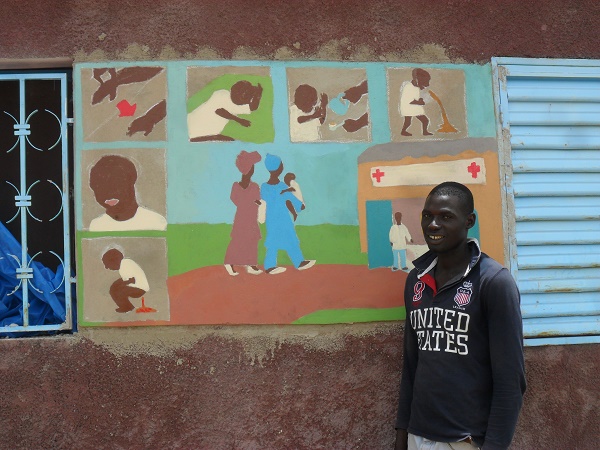 |
| Saare Sukande's ASC, Demba Balde, with his half-finished mural. I don't have any pictures of the painting in-progress because filling in the lines was the one part of the mural that required no real skill, therefore the only part I could help with. |
 |
| Me and Lauren and Demba, with the final product! |
 |
| Danger signs from bottom left - blood in the stools, fever, when pinched the skin does not rebound quickly [which is a sign of dehydration], lethargy, refusal to eat or drink, vomiting. Who but Lauren can make bloody diarrhea look this pretty? |
 |
| Leading his causerie. |
Update March 2016:
I have a new camera! Here are the rest of the murals:
 |
| Kountanto - danger signs of severe malaria |
 |
| Kansatan - causes of diarrhea (five F's - food flies fingers fluid feces) |
 |
| Complet model of nutrition |
 |
| Danger Signs of Malaria, at the Saare Meta Health Hut |
Sunday, July 26, 2015
Ode to my Cell Phone
If you’re an American reading this, you probably have a
smartphone. Smartphones are perfectly
suited to the American way of life. You
can look up the closest Thai restaurant that offers a student discount, read
reviews to choose what to order, place an order, and have your phone analyze
satellite traffic to provide the most efficient route before giving you GPS
voice guidance to drive there, all within 2 minutes. In America, cell phones make life easier.
My cell phone makes my life easier in Senegal, too. Though it could not be called “smart,” it is
perfectly suited for my environment.
My phone is tough. There are no carpeted floors here in my
Pulaar village. If you’re lucky, your
hut floor is poured concrete – if not, it’s packed laterite. Dropping an iPhone here could be fatal to it,
but not to my brick! There’s no
touchscreen to crack, no sensitive camera lens to dirty. I’ve dropped it dozens of times. Babies have played with it like a
hammer. I’ve tossed it across the
compound to my tokara when she’s
asked to use it. Though primitive, it’s
been a tireless champ, the Nile crocodile of cell phones.
The battery lasts
forever. My brick never leaves my
side. I’m a texting fiend, and I talk on
the phone far more than the typical villager.
Even so, I only have to charge it every few days. Most people in my village get by with
charging their phones once a week or so.
When the battery does need to be charged, it’s easy to do so. Find someone with a solar panel, drop it off,
and pay 100 CFA (about 20 cents) when you pick it up later.
 |
| My host brother Oussaman got a solar panel a couple months ago and he's been rolling in business. |
It has a built-in
flashlight. Those of you that don’t
understand how useful this is have probably never lived without electricity. It’s really goddamn useful.
It has a built-in radio. This is less useful than the flashlight, but still nice. I can't get any channels on it in my village, but it would probably work in a larger city. I've seen people with wire attached to their phones (like antennae) and headphone jacks in their ears, so presumably that works too.
The games are on
point. It came equipped with Snake,
Rapid Roll, Cricket Cup, Sudoku, and Forbidden Treasures. I still have no idea how to play Forbidden
Treasures (ironic...) but the other games are great. I favor Snake, but play the other games
regularly too. I probably never would have learned to play cricket if it wasn’t for my phone and my ample free time. Hidden Peace Corps perk!
 |
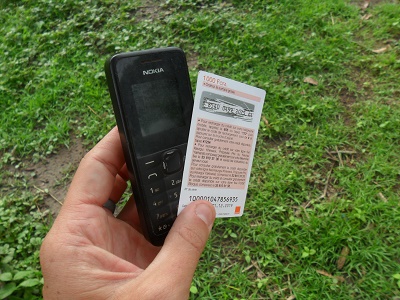
| Looks like nostalgia... |
It's well adapted for a chronically broke person to use. Cell phones here are recharged with purchased cards, each worth 1000 CFA ($2, but a lot of money in village). The cards can be purchased from any boutique. You scratch off the foil, type the numbers into the phone, and - voila! - you have about 30 minutes talk time.

If you're broke, no worries - there are no monthly fees, no contracts, no mandatory scheduled payments. If you can't afford credit and need to talk to someone, you can send them a text that says "Merci de me rappeler" (please call me) for free. The text recipient will see the message and call if they have credit. If your phone does have a fatal accident, it's easy to get by while waiting for money for a new one. The SIM cards are removable and transferrable to any other phone. One of my neighbors hasn't had a working phone for months, but she puts her SIM card in mine sometimes to greet her family in Mauritania.
It keeps me updated with other volunteers and admin. Text message alerts, called CPAs, come in frequently. These messages are great for keeping all volunteers in the loop about grant deadlines, safety and security issues, or administrative updates. They were especially useful during last year's Ebola epidemic. It was good to know that if something happened involving Peace Corps' position in Senegal, we would all be notified at the same time instead of relying on diluted gossip through the rumor mill. Volunteers also get free volunteer-volunteer calling, which is the best thing admin could have done for our mental health, in my opinion. Not a day goes by that I don't talk to someone in my Peace Corps family.
If you're broke, no worries - there are no monthly fees, no contracts, no mandatory scheduled payments. If you can't afford credit and need to talk to someone, you can send them a text that says "Merci de me rappeler" (please call me) for free. The text recipient will see the message and call if they have credit. If your phone does have a fatal accident, it's easy to get by while waiting for money for a new one. The SIM cards are removable and transferrable to any other phone. One of my neighbors hasn't had a working phone for months, but she puts her SIM card in mine sometimes to greet her family in Mauritania.
You can send money with it. I haven't utilized this feature, but it's been a lifesaver for my host family. A Western Union style system called Wari is really popular here. If you send someone a Wari, they just have to take their phone (with confirmation text) to a Wari station (they're everywhere, there's one 4k away from me), show the person working your ID, and collect your money. It's so easy.
The computer, iPod, and tablet I brought to Senegal from the states have all fallen prey to the harsh environment here. This is where electronics go to die. I have a friend who's gone through two kindles, a camera, an mp3 player, and two laptops. However, the brick cell phone is still as functional as the day I got it, and I'm thankful.
Monday, July 20, 2015
Rat Trap Blues
I woke up to fat, slow raindrops dripping through my shade
structure and on to my face. I scowled,
half asleep, and groped for my cell phone (which, due to its built-in
flashlight, is never more than an arm’s length away after dark). 12:42, it said. I pondered whether I should move inside to
sleep or whether the drizzle would stop soon.
In response, a thunderclap sounded and it started raining buckets. Blah.
I stumbled inside, half-asleep, carrying my partially sodden foam mattress, my path dimly lit by my cell phone’s flashlight. Something was wrong. Several books were strewn across the floor, not on my table where I'd left them. My shampoo bottle was laying on the ground, too, a small puddle of liquid pooled around its nozzle. And – what was that? – oh yeah, the glue rat trap I’d bought in Thies was upside down on the floor, too. As I looked, the trap suddenly clicked and scuttled towards me.
I shrieked and jumped. “Oh god oh god oh god oh god oh god!” After three kinds of rat poison hadn’t done the trick, I’d bought the trap hoping to catch the rat, but this possibility had honestly never occurred to me. I thought if the trap did work, the rat would die instantly and peacefully, allowing me to sanctimoniously drop it in my latrine hole with a shrug and a silent apology (“Well, I’m sorry, but you did it to yourself, you know.”) Unfortunately, the rat didn’t agree to that plan, and he wasn’t going down without a fight.
Five minutes passed, silent except for the wind and rain and my racing thoughts, completely dark except for my flashlight beam. I realized there was no way I’d survive a zombie apocalypse. I knew I was being a baby, but I still couldn’t move. It was just a rat! I reconsidered option 1, leaving the trap until morning. As if it were reading my thoughts, the trap moved, scraping noisily against my concrete floor. “Oh god oh god oh god oh god!” I shuddered, closed my eyes, and stomped the chaco as hard as I could in the center of the trap.
But the rat was not in the center of the trap. It was far off to one side of it. The trap was also not very well made – its surface was slick, wet, and barely sticky at all, the masking tape of glues. My stomp only served to slide the gluey cardboard off the rat’s back and onto his hairless tail. He yelped, scared and angry, then limped away from the trap unencumbered, his fur shiny with wet glue. I knew I should chase him. I knew I wasn’t going to chase him. I watched as he walked, fearlessly and purposefully, out my open back door into the rain. Lightning flashed and – I swear – he looked back at me over his shoulder before disappearing into the tall grass, where (I imagined) he’d clean himself off, gather his friends, and prepare a counter-attack.
I tucked my mosquito net in very carefully, telling myself the thin gauzy fabric was ample defense against a revengeful rodent. I eventually fell into a fitful sleep, had a mefloquine nightmare about Zombeavers, and woke up in a puddle of my own sweat.
Africa: 1, Kadiatou: 0.
I stumbled inside, half-asleep, carrying my partially sodden foam mattress, my path dimly lit by my cell phone’s flashlight. Something was wrong. Several books were strewn across the floor, not on my table where I'd left them. My shampoo bottle was laying on the ground, too, a small puddle of liquid pooled around its nozzle. And – what was that? – oh yeah, the glue rat trap I’d bought in Thies was upside down on the floor, too. As I looked, the trap suddenly clicked and scuttled towards me.
I shrieked and jumped. “Oh god oh god oh god oh god oh god!” After three kinds of rat poison hadn’t done the trick, I’d bought the trap hoping to catch the rat, but this possibility had honestly never occurred to me. I thought if the trap did work, the rat would die instantly and peacefully, allowing me to sanctimoniously drop it in my latrine hole with a shrug and a silent apology (“Well, I’m sorry, but you did it to yourself, you know.”) Unfortunately, the rat didn’t agree to that plan, and he wasn’t going down without a fight.
My heart was racing.
I cowered in my rain-drenched sleep shorts as I considered my options.
1.
Ignore it until morning and make my host brother
deal with it. Although this was the most
attractive option, it was not possible.
It was raining too hard for me to go back outside, and I doubted the rat
would sit still until daylight. I wouldn’t
be able to sleep with it running all over.
2.
Toss the whole mess outside, rat, trap, and
all. That would mean touching it, which there was no way I
was going to do. Rat scratch fever,
Hantavirus, the plague…no.
3.
Kill the rat.
I didn’t want to do this, but I couldn’t think of any other
possibility.
I reluctantly strapped a chaco sandal on my right foot and
breathed deeply, trying to get up the nerve to stomp the trap. I wished I’d brought a nice thick baseball
bat to Senegal for this occasion. The
trap was still now, which I interpreted as the rat silently and serenely
accepting his fate. I muttered
encouragements to myself. “Come on, Barb.
You’ve got this. Just do it. You can do it.”
Five minutes passed, silent except for the wind and rain and my racing thoughts, completely dark except for my flashlight beam. I realized there was no way I’d survive a zombie apocalypse. I knew I was being a baby, but I still couldn’t move. It was just a rat! I reconsidered option 1, leaving the trap until morning. As if it were reading my thoughts, the trap moved, scraping noisily against my concrete floor. “Oh god oh god oh god oh god!” I shuddered, closed my eyes, and stomped the chaco as hard as I could in the center of the trap.
But the rat was not in the center of the trap. It was far off to one side of it. The trap was also not very well made – its surface was slick, wet, and barely sticky at all, the masking tape of glues. My stomp only served to slide the gluey cardboard off the rat’s back and onto his hairless tail. He yelped, scared and angry, then limped away from the trap unencumbered, his fur shiny with wet glue. I knew I should chase him. I knew I wasn’t going to chase him. I watched as he walked, fearlessly and purposefully, out my open back door into the rain. Lightning flashed and – I swear – he looked back at me over his shoulder before disappearing into the tall grass, where (I imagined) he’d clean himself off, gather his friends, and prepare a counter-attack.
I tucked my mosquito net in very carefully, telling myself the thin gauzy fabric was ample defense against a revengeful rodent. I eventually fell into a fitful sleep, had a mefloquine nightmare about Zombeavers, and woke up in a puddle of my own sweat.
Africa: 1, Kadiatou: 0.
Saturday, July 11, 2015
Family Bonding.
"Konk Konk," said my favorite host sister, Meadow, from my open hut door. I looked up from The Poisonwood Bible, smiled, and welcomed her inside. We went through the normal round of greetings, ending when I asked what was new and she sighed and said nothing. The visit wasn't unusual - it's Ramadan, and afternoons are boring. There's no lunch preparation or afternoon tea to break up the day, and most people spend the afternoon napping. The village is a total dead zone from around 2pm until break fast around 7:30. I'm not fasting this year, so many kids (who also don't fast) use "visit Kadiatou" as an afternoon activity. I have some picture books brought back from America that kids are welcome to read as long as they don't remove them from my hut. Meadow picked up a book she'd already "read" many times and started turning the pages. Ten minutes elapsed - I forgot she was there. The Poisonwood Bible is a very good book. Finally, she spoke.
"Tomorrow, I might go to a dennabo (naming ceremony)," she said.
"Yes, me too!" I replied happily. Several people had told me about the dennabo already. It was supposed to be a huge affair, with speakers and cold boissons biked in from Velingara in coolers. Usually, parties don't happen during Ramadan, but they made an exception for this one. It was going to start right at break fast and continue well into the night. I was really looking forward to it.
Five more minutes elapsed in silence. The Poisonwood Bible is a very good book.
"Aliou's washing tonight," she said nonchalantly.
I was fairly certain I'd heard correctly but had no idea who Aliou was or why she was telling me this. "Oh yeah? What we will he wash? Clothes?"
"No, I said Aliou," she slowly clarified. "Aliou Balde."
"Awa," I said with a shrug. OK.
Meadow didn't give up. "Aliou Balde," she said again. She pantomimed washing her hair. I remembered that was the name of the man in town that washes womens' hair. They just go to his compound and pay 200 CFA (roughly 40 cents) and he lathers them up.
"Awa," I said again. The town hair washer, who washes hair every night, was washing hair that night. That was a weird thing to tell me. Must have been a slow news day in Teyel.
More time elapsed. The Poisonwood Bible is a very good book. Finally, I felt Meadow's stare piercing me through the pages. I looked up and recognized the pleading look in her eyes. Realization hit me like a beam of lightning.
"OH! I UNDERSTAND!" I exclaimed. I was proud of myself for figuring it out but embarrassed that it took so long. Meadow looked relieved. I stood up and got a 200 CFA coin from my wallet to pay for Meadow to get her hair washed for the party.
Then I decided to mess with her a little bit. Like all big sisters, I'm kind of a bully.
"You will wash the hair until you're clean?" I asked. I accidentally used lootde, to wash, instead of looteede, to get washed. Reflexive endings are hard and I forget a lot. Meadow didn't correct me like most 13 year olds would ("no, I'll get washed, dummy!"). She just politely said yes.
"You have a friend there?" I enquired. She just smiled shyly. I kept digging. "A boy friend?" I prodded. Just like in English, "boy" and "friend," innocent when separated by a space, combine into a far more loaded word. Sahel gorko could be nothing, a friend who's a boy, or a real boyfriend. I said the words close together, in a way that was teasing yet kind (I hoped.)
Meadow put her head in her hands and laughed, embarrassed. If her skin were paler, her face would be blushing beet red.
"Now I understand!", I squealed, throwing my pillow at her. "What's his name?"
We both laughed. I waited for inspiring Full House theme music to bubble up, incited by this lovely heartwarming family moment. Instead I heard only roosters and goats.
"Meadow," I said slowly. "You will go to school next year."
She solemnly nodded.
"And the year after next, and three years from now." (This is easier to say in Pulaar - e ñatigaro, e ñatagaro)
I tried to make meaningful eye contact, but Meadow was looking at the door. She had gotten her money and I was acting a little too much the nosy big sister. She glanced back and recognized the pleading look in my eyes.
"Oh! Yes! School! I will go to school," she assured me.
I kept looking at her.
"I will have girl friends only."
We laughed and said "let us spend the afternoon in peace" - a mouthful in English, but three simple syllables in Pulaar, ñallen jam.
"Tomorrow, I might go to a dennabo (naming ceremony)," she said.
"Yes, me too!" I replied happily. Several people had told me about the dennabo already. It was supposed to be a huge affair, with speakers and cold boissons biked in from Velingara in coolers. Usually, parties don't happen during Ramadan, but they made an exception for this one. It was going to start right at break fast and continue well into the night. I was really looking forward to it.
Five more minutes elapsed in silence. The Poisonwood Bible is a very good book.
"Aliou's washing tonight," she said nonchalantly.
I was fairly certain I'd heard correctly but had no idea who Aliou was or why she was telling me this. "Oh yeah? What we will he wash? Clothes?"
"No, I said Aliou," she slowly clarified. "Aliou Balde."
"Awa," I said with a shrug. OK.
Meadow didn't give up. "Aliou Balde," she said again. She pantomimed washing her hair. I remembered that was the name of the man in town that washes womens' hair. They just go to his compound and pay 200 CFA (roughly 40 cents) and he lathers them up.
"Awa," I said again. The town hair washer, who washes hair every night, was washing hair that night. That was a weird thing to tell me. Must have been a slow news day in Teyel.
More time elapsed. The Poisonwood Bible is a very good book. Finally, I felt Meadow's stare piercing me through the pages. I looked up and recognized the pleading look in her eyes. Realization hit me like a beam of lightning.
"OH! I UNDERSTAND!" I exclaimed. I was proud of myself for figuring it out but embarrassed that it took so long. Meadow looked relieved. I stood up and got a 200 CFA coin from my wallet to pay for Meadow to get her hair washed for the party.
Then I decided to mess with her a little bit. Like all big sisters, I'm kind of a bully.
"You will wash the hair until you're clean?" I asked. I accidentally used lootde, to wash, instead of looteede, to get washed. Reflexive endings are hard and I forget a lot. Meadow didn't correct me like most 13 year olds would ("no, I'll get washed, dummy!"). She just politely said yes.
"You have a friend there?" I enquired. She just smiled shyly. I kept digging. "A boy friend?" I prodded. Just like in English, "boy" and "friend," innocent when separated by a space, combine into a far more loaded word. Sahel gorko could be nothing, a friend who's a boy, or a real boyfriend. I said the words close together, in a way that was teasing yet kind (I hoped.)
Meadow put her head in her hands and laughed, embarrassed. If her skin were paler, her face would be blushing beet red.
"Now I understand!", I squealed, throwing my pillow at her. "What's his name?"
We both laughed. I waited for inspiring Full House theme music to bubble up, incited by this lovely heartwarming family moment. Instead I heard only roosters and goats.
"Meadow," I said slowly. "You will go to school next year."
She solemnly nodded.
"And the year after next, and three years from now." (This is easier to say in Pulaar - e ñatigaro, e ñatagaro)
I tried to make meaningful eye contact, but Meadow was looking at the door. She had gotten her money and I was acting a little too much the nosy big sister. She glanced back and recognized the pleading look in my eyes.
"Oh! Yes! School! I will go to school," she assured me.
I kept looking at her.
"I will have girl friends only."
We laughed and said "let us spend the afternoon in peace" - a mouthful in English, but three simple syllables in Pulaar, ñallen jam.
Subscribe to:
Posts (Atom)