Disclaimer

The contents of this Web site are mine personally and do not reflect any position of the U.S. Government or the Peace Corps.

Sunday, January 25, 2015

di satti, kii

I was livid.  I shot another accusing glance at the uniformed young man sitting on his comfortable chair outside the bank. “Fad seeda,” he said calmly.  Wait a little.  “Jooni jooni di wadtat.  Jooni jooni.”  Very soon it will be fixed.  Very soon.  He kept pouring his attaya from one glass to another with great flourish, building up the foam.  Attaya is the most Senegalese of Senegalese traditions – it is normally a 3-minute task to boil tea leaves and sugar in water, but enough ceremony is added here to stretch it into an hours-long afternoon activity that cannot be rushed.

I looked at the sun, uncomfortably close to the western horizon.  “Mi waawaa fadde nannde fuf!” I exclaimed haughtily. I can’t wait all day!  “Nannge fataata haygooto.  Mi foti hootde jooni jooni.  A wii’ii ‘jooni jooni’ wahktuji didi to baawo.  A rimi!”  The sun waits for no one.  I need to go home very soon.  You said “very soon” two hours ago.  You lied!

Eight months ago, I’d have never thought I’d chew out an innocent employee.  Polite Barbara is still a part of me, somewhere, but she’s obscured by an ever-thickening layer of Kadiatou, and Kadiatou’s a bitch.  The employee was unmoved by my tantrum.  “Wonaa lob,” he said.  Don’t be mad.  He kept pouring attaya, the expression on his face making it clear that he couldn’t care less whether I was mad or not.

Beside me, the bakery erupted in screams again.  Someone must have scored a goal in whatever Africa Cup match was currently going on.  The young man lifted his head, like a guard dog catching a scent, and dashed inside to investigate. The bakery next door was crowded with young men gathered around a 90s-era box TV whose screen couldn’t have been more than 12 inches.  I could barely make out the tiny figures dashing around the soccer field in the screen, but that didn’t seem to deter any of the spectators.


 In a few seconds, the uniformed man emerged and told me the new score.  “Haa,” I agreed, hoping the expression on my face made it clear that I didn’t care.  I’d heard a theory that the Africa Cup was behind the power outages that’d been afflicting Velingara the last few days.  During an important match, everyone turned on their TVs and radios at the same time, overwhelming the grid.  I didn’t know if there was any truth to it, but either way I was prepared to hold a grudge against soccer.  It was soccer’s fault the ATM had to be reset in the first place.  It was soccer’s fault I was waiting.


I stretched my legs in front of me and leaned over my knees, touching my toes, trying to alleviate the nagging pain in my butt.  My thighs had quickly adapted to my biking regiment here, building up muscle until my weekly 30K bike ride and from Velingara was no longer difficult, but my flat Midwestern behind still hurt after a few hours on a bike seat.  I took a couple deep, calming breaths, but that only made me madder, as the bakery next door was emitting sweet buttery pastry smells 300 CFA out of my reach.  I was hungry, I was tired, and it was looking like I still had to bike another 15K to get home, since I didn’t have 400 CFA for a car.


I had been penniless for about a week at this point.  The past few times I’d gone to Velingara the ATM had been broken, too, which didn’t bother me much, since I could just kept stretching the little money I had.  Now, however, I was alaa haymbuudu, flat broke, and it was really starting to hurt.  I could no longer afford my normal bean-and-mayonnaise breakfast sandwiches.  I had to go to a dennabo (naming ceremony) empty-handed, a major faux-pas for the rich toubab.  I couldn’t even pay the 100 CFA to charge my phone at the town’s solar charger, so I’d had to ration my usage to make the battery last.  Earlier that afternoon, Liz, one of the volunteers in Velingara, had been nice enough to check the bank to make sure the ATM was working before I wasted the hour and the energy biking into her town.  I must have gotten there mere minutes too late.  The uniformed man had told me to sit and wait, that he was sure the ATM would be working again soon.  “Miin poti la machine redemarrage, quoi," he had explained in a mix of bad French and good Pulaar.  I had imagined the restart process for my laptop – five minutes, max.  “Awa,” I had said cheerily. OK.  I could wait. I took a seat on the edge of what had probably formerly been a garden planter, but was now just another container for garbage.

As the next two hours passed, hanger and irritation set in.  Every 15-20 minutes, the uniformed man would encourage me it would just be a few more minutes.  Finally, I decided I could wait no more.  I calculated the amount of time needed to bike home vs. the amount of light left in the day and decided I needed to leave immediately.  Not only was the potholey road difficult to traverse by flashlight, but many cars here do not come equipped with headlights, and as it got darker it got more likely that we might crash.  There were also rumors of bandits that came out after dark, not to mention the hyenas and baboons.  I said a few more impolite words to the guard, told him he was lazy and a liar, and that I was very angry.  He laughed at my bad Pulaar and waved goodbye.  


I biked home as fast as I could, racing against the sun.  I finally pedaled into my village at late twilight, out of breath, tired, sweaty, hungrier than ever – and still broke.  


“Sabaly!” called a voice as I coasted by the middle school. I put down my feet to brake, Flintstones style, since I hadn’t had money to get my brakes repaired at the local mechanic. 

“Mballo,” I said, recognizing the speaker, a friendly old man who could usually be found under the shade tree by the middle school. 
“Sabaly,” he repeated. 
“Mballo,” I said, touching my right hand to my chest in an expression of respect.  This continued several more times, each of us stating the last name of the other.  Finally satisfied, he moved on.
 “Horo jahno-daa?” he asked.  Where were you?
“I went to Velingara,” I said in Pulaar.
“Oh! That is far!” he replied.  “How were the people of Velingara?  Were they in peace?”
“Sort of,” I answered.  He smiled again and tilted his head.  I was going off-script here.  I was supposed to say “Jam tan,” peace only, and move on.
“I don’t have any money,” I explained.  “And the machine at the bank was broken.”  He clicked his tongue in sympathy and nodded twice.  For some reason I continued, compelled by his kind body language and serene smile.  Before I knew it, I had vented all my frustrations of the whole awful afternoon at him. “And now it is dark and I’m tired and I’m hungry and I still don’t have any money and the guard lied to me!” I finished.
Mballo smiled.  “Di satti, kii,” he said.  It’s hard indeed.  “Life here is hard, Sabaly.  Don’t be mad.”

I wished I had more time to talk, but it was almost completely dark now, dark enough that I needed to walk my bike because it was no longer safe to ride it.

“It’s getting late,” I told Mballo.  I’m going home.  You should go home, too.” 
“Oh, no!  I will lay here tonight.” He waved his hand to indicate the space under the shade tree. 
I was flabbergasted.  “What?! Why?!” I asked, hoping that I had misunderstood.
“I guard the school,” he said.  They say they will pay me jooni jooni, but the money does not come.”  He shrugged, content.  “What can I do?  Life is hard.”


My white guilt, always at a low simmer here, erupted into a furious boil.  I looked at my friend’s clothes, realizing that they might be the only ones he had.  I looked at the smooth dry dirt underneath the tree, worn down by his sleeping there for months.  I noted his lack of a mosquito net – his lack of a blanket – he didn’t even have a plastic mat to sleep on.  I felt disgusted and ashamed of myself, self-conscious of the privilege I take for granted far too often.  How could he be so happy while I had felt so persecuted?  


I wished Mballo a good evening and walked the rest of the way home in a daze, reframing the day’s events as a Senegalese might have seen them.  True, I didn’t have any cash, but neither does anybody else here.  I have a good, kind family that gives me food for free – I have a working bike that brings me where I need to go – I have my health.  Even when I’m broke, I’m still incalculably rich.  I need to try harder to remember that.

Thursday, January 8, 2015

Gonna get new shoes, come pickin' time....

My family here in Teyel has lots of fields.  The corn, rice, and millet are for eating, but the cotton is for selling.  For the last few months, my brother has been talking wistfully about all the luxuries he'll be able to afford when the cotton check comes in...things like eggs, meat, vegetables, and shoes for his kids.  Maybe even a new cow.

This year was my first experience as a cotton farmer.  It's a lot of work when you don't have machines to do any of it for you. I only went out to the fields a few times, whereas my aunts went every afternoon for weeks (after they had already finished an exhausting morning of pounding, cooking, sweeping, and washing).

It's a gorgeous 15-20 minute walk through the woods to get to the fields, but it is less gorgeous when you have to do the walk when the sun is hot and you're sweating profusely.  

My sister Asu, somehow looking like a model despite the beating sun.  Thankfully not pictured is me, a red sweaty mess of a toubab with flies all over her face.
After the soft pillowy cotton was picked, we put it in a bag, usually an old rice sack. When the rice sack was full, we shoved it down and fit more in, hoping we didn't inadvertently anger a blister beetle.  Cotton is sold by the kilo, so they try to fit as much of it into as little space as possible.  When the sack can't possibly hold any more cotton, they take it to a storage area, either in/near the field itself, like this:


Or in an extra hut in the family's compound, like this:


Unfortunately, there was an "accident" in Teyel a couple weeks ago, and all the cotton in one holding area got burned.  It was definitely arson, as nothing nearby was burned except the cotton, and it will probably always remain an unsolved mystery - the Law and Order: Teyel squad is not quite as efficient as their New York brethren.  The damage was not as bad as it could have been, because many people woke up during the commotion and pulled water from their wells, then ran over with buckets to drench the piles, so only the outside shell was ruined.  The cotton inside was still okay, though wet.


My neighbor Korka is one of those whose crop was burned.  He removed the damaged cotton, piece by piece, then carefully spread out the unburned remainder so it wouldn't mold.  All the others affected by the fire did the same.

Goofball.

The trucks came to weigh all the cotton just a couple days ago.  My family loaded up the donkey cart with this year's crop (it took several trips to get it all) and unloaded it at "Le Centre," where the cotton bigwigs were waiting with their scale and receipt books.


Since this is Senegal, the land of waiting, the process of weighing and loading Teyel's cotton took two full days to do.  Luckily, a huge pile of fluffy cotton makes a pretty comfortable chair while you're waiting for your turn at the scale, and attaya stoves are portable.  There were even a few enterprising teen boys selling popsicles they'd biked in in coolers from Velingara.


Some of my neighbors balancing their crop on the slide scale.


And just like that, the trucks drove away, the crop was gone, the work was over, and a check for an unfathomable amount of money ($600 US dollars) was in my brother's hand.


Success.

Sunday, December 28, 2014

Cake!

I like parties.  Everyone likes parties.  The best thing about parties is that dancing and eating require no language skills.  Since I have spent most of the last year without language skills, I have thrown many parties here.  I reasoned that although I eventually wanted my service to be about more than parties, there was nothing wrong with making people like me. It is universally true that a good way to make people like you is to give them cake.

I told a couple other PCVs about making cakes in village and was met with either dumbfounded stares or enthusiastic badgering for how I did that.  It's really easy!

Acquire a gas burner, or fire and sticks, or a charcoal stove and charcoal.  I've only done this with my gas burner but I'm sure you can do it with other heating methods as well.  Heat is heat.  Put a thick sturdy pot with a lid on your heat source.


Put something in the bottom of the pot to prevent your cake pan from touching the hot burner, since if it got too close it could scorch the bottom.  I use either a flat metal plate (if I'm making muffins) or a small upside-down bowl (if I'm making cake).  Doing this effectively means that your batter will be surrounded entirely by hot air, and that's all an oven is.

Four muffin tins on a metal plate.
Turn the heat on low and keep it covered until they're cooked.  A 6-inch diameter cake will take about a half hour, these muffins take about 20 minutes.

mmmmmmm
That's it!

Suffee cutting up a round peanut butter cake


When you can make a middle aged woman dance without music, you know you're doing something right.

Recipes:

Muffins:  mix 3 cups flour (part of this can be millet or corn flour), 2 cups sugar, 1 tsp baking soda or powder (I know they're not the same - I think powder is better, but there's only soda at my local boutique and that tastes fine too), 1 tsp salt, and 1 tsp cinnamon (if you've got it).  In another bowl mix 4 eggs and 1.25 cups oil.  Stir the dry and wet ingredients together.  Throw in whatever additions you think might be delicious, especially vanilla if you've got it.  Cook in little metal cups - I bought them in Thies, they're probably in many markets if you look around.  You can cook muffin batter in a cake pan, too, to make a giant muffin-cake.

Peanut butter cake:  mix .75 c margarine (the Jadida they sell at boutiques works fine), .75 c peanut butter, 3 eggs, 2.25 c sugar, 2.25 c flour, 3 tsp baking soda or powder (like the muffins, i think powder is better but soda works too), .75 tsp salt, vanilla if you've got it, and a cup of milk (or Vitalait in water).

Coffee cake:  mix 1 c sugar, 1.75 c flour, and 2 t baking powder or soda, work in 4 T butter with a fork or your fingers, add 1 beaten egg and 0.5 c milk, sprinkle 1 tbsp sugar mixed with 1.5 tsp cinnamon on top.  

Sunday, December 21, 2014

Mbo fuddi ligge makko, seeda seeda...

Hello internet.  It's been awhile.  I guess I haven't written much lately because I've been somewhat busy. I usually have something work-related to do every day now, which feels really nice.  My village has been proud of me for finally being a productive volunteer - the title to this post, "Mbo fuddi ligge makko, seeda seeda!" is a boast I overheard my brother make from his seat at a breakfast stand when I was walking to the community garden a few days ago.  "She's starting her work, little by little!"

The big project I've had going on lately was a supplementary feeding program with mothers of malnourished children in Biaro, a village 2k from Teyel.  The last baby weighing showed that there were seven "babies" (kids under the age of two) who were underweight.  Each mother agreed to pay 300 CFA (about $0.60, but that's a lot of money in village) and to provide millet, corn, or rice flour when it was her turn to cook.  Every day at 10am, we'd meet as a group, and whoever was cooking that day made a normal weaning porridge (just grain and water) then we put in healthy additives to make the porridges more nutritious - like peanut butter and banana, or tomato and bean, or crushed peanut and moringa, and we talked about the Complet Model of Nutrition.  The kids would not only eat at the program, but would take home some more porridge for a healthy afternoon snack.

I didn’t expect everything to go perfectly smoothly – Peace Corps training taught me to expect the unexpected, to be flexible and enjoy the ride and try to avoid getting frustrated by inevitable setbacks.  I thought I went in to the project with that mindset, but there was still a lot of stuff that didn’t go as planned and I still got stressed and irritated in spite of myself.  

The first day of the program, I had my ASC (community health worker) come in and explain in his fluent Pulaar why I was doing the program and what the Complet Model of Nutrition means.  

We did an activity where the women placed laminated cards of foods onto the part of the complet where they belonged – fruits/veggies on the headscarf, proteins on the shirt, and grains on the skirt. 
All the women agreed to meet at the first woman (Sadio)’s house the next morning (Sunday) at 10 to start the program.

The next morning, Sadio informed me that she was not feeling well and would not be cooking that day. I tried to convince her that babies still needed to eat regardless of whether their moms were well or not, but it was no use.  She told me she had already told all the women the start date of the program would be postponed one day, so I wished her a speedy recovery and went home.

The next morning, Monday, I went to Sadio’s house, and she told me none of the women could come, since Mondays are market days and they would not have time.  I went around to a few compounds and saw that she was right – only three of the seven women were at home.  I was irritated, but still trying to flexible and understanding.  This was literally a program meant to give free food to hungry kids and I was amazed that it was so difficult for me to do it.

Tuesday morning I went back.  Sadio was not at home, and her neighbor told me she had gone to the nearby health post because she still wasn’t feeling better.  I was visibly upset, since I had had such high hopes for the program, so the neighbor, Booyah, who’s as awesome as her name is, said she would cook the porridge that day.  

All the women (except one, who was still MIA) came over, and as the babies ate we discussed the nutrition in the day’s meal.


Wednesday and Thursday went well, too.  Except the one missing woman (who I learned had fled to her parents’ village because of a fight with her husband), everyone attended and the babies had big appetites.  The mothers grew more confident in explaining low-cost and high-energy food additives to help kids gain weight, and though it might have been my imagination, the kids seemed to have more energy.

Friday, three of the seven women were absent, and by Sunday, there was only one left.  The women said the program was good, but that they didn’t have time to do it for that long.  I'm trying to see the program as a success - even if they only went a day or two, at least it didn't hurt anything, but it was not the intensive weight-gain boot camp I had planned.  

While that was going on, I also did a Senegal map mural in Dinguera, the same school with the same awesome work counterpart where I did the handwashing project.  My neighbor Lauren has an artistic streak and was glad to help me.  It ended up looking pretty great, though it's not quite finished yet in these pictures.  The paint didn't dry enough to label the regions yet.


Another day, my PCV friend Liz came over and did a training for a local womens' group on soapmaking.


I also spent a morning helping to seed an onion nursery and prepare garden beds in one of the women's gardens.


So, that's about it.  I know that doesn't seem like a lot, considering it's my whole month's work, but it's something.  It's hard to believe it's so late in the year already...to answer that annoying 1980s song, no, they DON'T know it's Christmas, and they don't care, because they're muslim.  Every day continues to be exactly the same as the one before it, but it's nice and I'm still enjoying it.

Catch up with you all later!  Thanks for reading!

Saturday, December 6, 2014

Packing Tips for 2015's Senegal PCVs

This blog’s niche, so sorry to everyone reading who is NOT coming to Senegal to be a health volunteer and is not interested in my opinions of what/what not to pack. I just remember that I perused tons of blogs looking for tips about packing when I was in this next group’s position.  Some people’s blogs I agreed with, some I didn’t…some I wish I’d listened to, some I still think were crazy (I’m talking to you, Miss “I Packed 50 Pairs of Underwear”). 

I’m not going to go through everything in my suitcase in minute detail.  Yes, you’ll need clothes.  People wear clothes here.  Bring clothes.  How many and what kind of clothes you bring are up to you.  Remember, you’re coming to a country that millions of people live in, so anything you need to live, you can find here.  If you forget something, it’s not the end of the world.  I’m just going to list off some things I brought and was happy about, some things I brought that ended up being ridiculous, and things I wish I’d packed but didn’t.  This blog is just my own opinion, so take it with a big chunk of salt. 

Things I packed and am happy for:

My prescription sunglasses.  If you wear glasses, go to zennioptical.com and order yourself a pair.  They’re less than 20 bucks and you’ll wear them every day.  I didn’t realize before I got here how much time I’d be outside.  People in my village literally only go inside their huts to sleep.  The rest of the time they’re hanging out on benches under mango trees.  Sometimes they even sleep under the mango trees.  If something were to happen to my zennis, I could get by with normal glasses, but I really hope that never happens. 
A warm hoodie and sweatpants. I felt like an idiot when I got here in March with those things because it was hot season and it was too warm to think, even in the middle of the night, but now I’m grateful that I have clothes appropriate for cool season, because it does get chilly sometimes now.  Of course, if I would not have packed them, they would have been available at any fukkijai (used clothing boutique), so if you don’t have room in your suitcase, no worries.
A big bottle of shampoo and conditioner.  There is a nice foreign goods store in Thies (the city where the training center is) but you’re not going to be allowed to leave the training center for your first week.  I shared my shampoo and conditioner with many grateful girls who had only brought a tiny travel size.
All my makeup.  I brought it all because I figured my Peace Corps service was two years long, and by two years from when I left it would all be expired anyway – cosmo says you’re supposed to throw out mascara after 6 months – and I didn’t have enough makeup that I felt it took up too much luggage space. I don’t wear makeup in village very often, but I do for parties and holidays, and I have a lot of fun giving makeovers to my favorite pre-teens in village.  Also, I never wear nail polish, but PCVs that do say they’re happy they brought some with them.  The local stuff’s not the best quality.
LOTS of exercise clothes.  I brought with two spare pair of running shoes and am very glad I did.  I run almost every morning here to help me keep some degree of sanity and am already on pair #2.  I might be able to find good running shoes in Dakar, but almost certainly couldn’t find the exact size and brand that I prefer (Saucony kinvara, man size 8.5, you are amazing and I love you).
A hammock.  I’m in the casamance and there are lots of trees here, but there are not trees everywhere in Senegal, so packing this one was a bit of a gamble, but I’m glad I did it.  There are few greater tranquilities than hammocking in a jungle studying Pulaar flash cards with gorgeous tropical birds flitting about, singing pretty songs at you.
A camera.  You’re not NOT going to bring a camera, are you?  Come on.  You need a camera.  If you’re one of those types that uses their smart phone as a camera in America, I think it’d be worthwhile to get a cheap used digital camera instead.  The battery lasts longer and it’s less of a show to bring it out in village.
Plastic bags. I probably brought too many of these, but I am glad I bought some.  Unfortunately, ants CAN chew through them, so you can’t store food in them (RIP to the delicious sugar roasted nuts that taught me that) but they’re good to keep other things clean and dry.  Plus, if you give a village woman one of them, she will pray you some great prayers.  Ziplocks are very popular.
A few nice sturdy tupperwares with snap top lids. Thick plastic is ant- and mouse-proof, so these are good to store food in.
A swimsuit. There are pools in Dakar and Kolda for sure, and I’d wager that there are some in other cities as well.  They’re frequented by ex pats, not by Senegalese people, so don’t worry about packing a lil bikini if that’s your thing.  It’s not inappropriate.

Things I packed that were stupid:

Cooking spices.  I lived in Korea for a while, and while I was there I had fierce cravings for American food. As a result, when leaving for Peace Corps I packed tons of taco seasoning, cilantro, oregano, lemon pepper; all the stuff I thought might be hard to find here in Senegal.  I never use them.  I live with a family who does all my cooking for me, so I never use them for preparing my own meals, and Senegalese people (people in general, I suppose) are resistant to new tastes, so my family’s not interested in them.  In the last six months, there have been two instances I’ve used the spices: both occurred when everyone I normally share a bowl with wasn’t back from the fields yet when the meal was ready and the cook told me to eat alone in my room rather than wait for it to get cold.  Cinnamon made the gosse girte taste better, and garlic salt made the lecciri jambo taste better…but when I offered some of the improved dishes to my sister to taste she crinkled her nose and disagreed emphatically.  There are some volunteers that really enjoy cooking American meals at the regional houses, but I am not one of them.  It’s much cheaper and easier to go to restaurants.  You can get the best omelet, onion, and mayonnaise sandwich on warm fresh baked bread with a cup of delicious tea for less than $1 AND not have to do dishes.
Dress shoes (both heels and flats).  I thought there might be instances where I’d want to dress up nice and feel like a pretty lady, but this is NOT the way to do it. I live in the “deep south” of Senegal, the least sandy area in the country, and it’s still too sandy to walk in heels here.  It’s just not possible.  Don’t pack heels.  Senegalese woman do wear special dress shoes for holidays (or for every day, if they’re fancy) but the dress shoes here are nothing like dress shoes in America.  They’re $3 flip flops with rhinestones or triangles of colorful plastic attached instead of the normal everyday $1 flip flops.  Closed-toed flats are a sweaty mess here.
Hiking boots. I thought I’d be outside all the time, hiking, gardening, walking through the woods, and I’d need good protective footwear.  I am outside all the time, and I do do all those things, but I do in them in $1 flip flops.  Everyone here does.  You can too.  You will.  Really.
Jewelry.  I didn’t bring anything REALLY nice, but I brought a few of my favorite rings and necklaces, figuring that they were small and it probably wouldn’t hurt to have them just in case I felt like wearing them.  They are all rusting or corroding away and some kind of insect ate my peacock feather earrings.  If you wear something every single day, bring it, but be aware that everyone you encounter will demand that you give it to them.  If you just want to bring it because you think you might feel like wearing it here, don’t.  It’s far safer to keep it in the land of climate control and leak-proof roofs.
Dress pants and a cardigan. Peace Corps says you should bring “business casual” clothes to staging before you leave the country, but please for your own sake keep this as close to the casual side of business casual as you can.  “Dressing up” in village means your clothes have minimal holes and are clean.  My dress pants are ridiculous in village, like a parody of a rich person costume, and they have been in the bottom of my trunk at the regional house since I got here.
A speaker for my iPod.  This wasn’t stupid, just needless.  This radio is available at any market for 5 mille (about $10).  There are slots on the side for USB and memory cards.  You can transfer songs you want from your computer to the USB or the card, slap in some batteries, and have a dance party anytime.  AA batteries for the radio are available from any boutique – for forty cents you get about four hours of listening time.  It’s local, it doesn’t need electricity to charge, it’s real sturdy and hard to break, and it doesn’t scream “I’m rich so please ask me for money because I have so much of it” like my expensive American speakers do.


Things I wish I’d packed but didn’t:

A tent/bug hut.  I remember what was going on in my head when I decided not to bring my tent.  “I’m not going camping!” I thought.  “I’m going to LIVE there.”  Yes.  That’s true, I do live here, and when I’m at home, I’m very comfortable sleeping in my hut with my own bed.  However, PCVs travel a lot.  I regularly spend the night at regional houses or in other volunteers’ villages, and other volunteers come to my village, as well.  It’s a good idea to have a tent in the Peace Corps because it’s much easier than having a spare bed/mattress/mosquito net for guests or for your own travel.  I acquired a tent now from someone who COS’ed, but for my first 6 months here, whenever I traveled I either had to bring my mosquito net and find somewhere to string it up, which was a pain, or sleep without one and get bitten by malarial mosquitos, which was a worse pain. 
A solar charger.  Usually I charge my computer battery up as full as I can whenever I’m near electricity, then use a USB charger to charge up my cell phone and MP3 player using my computer battery while I’m at site.  This process works fine, but it’d be nice to have a solar charger instead, since that would help my computer battery last longer.  My computer is supposed to have an 11 hour battery life, and it probably does usually, but using the battery to charge other electronics makes it die much sooner for me.  If I would have packed a solar charger I might be able to use my computer battery to write more, or at least to rewatch Breaking Bad.
Notebooks.  Notebooks are available here, but Senegalese people prefer to write on tightly-ruled graph paper (I think Europeans do, too) and I do not.  I wouldn’t go crazy with bringing Target’s entire Back to School aisle, but I don’t think you’d regret throwing in a college-ruled spiral bound or two.  Bring some nice pens or gel pens (or GLITTER gel pens!) too if you want to write letters back home – nothing’s available here but cheap ballpoints.  They’ll get you by, but they’re not great.
A kindle or other e-reader.  The regional houses provide me with more paperbacks than I could read in a dozen Peace Corps services – but they also provide me with terabytes of hard drives of unlocked Kindle books.  I find great books at the regional houses and I like the excitement of trying something new after happening upon it on the shelf, and I like that my paper books don’t break if they get rained on or sand gets in them, but it would be nice to have access to anything I wanted to read, anytime I wanted to read it.  The perfect example of this is that I’ve read 1, 2, and 4 of the Game of Thrones series, but I can’t finish it unless I happen to find the other two.  It’s a treasure hunt, so that’s kind of exciting, but if I had a kindle, I could have read them already.  On the other hand, there are many wonderful regional house books I’ve read that I might not have if unlimited kindle variety had been available. 
Band aids. Med does supply band aids, but the quality is not the best (meaning they barely stick at all), and rainy season foot infections cashed out my entire stash in about two weeks.  After I ran out of band aids, I used medical tape and gauze that I bought at a pharmacy in the nearest city, but band aids are better.  If you bring a box of those nice cloth ones, the ones that could stay on through a marathon, you probably won’t regret it.

Well, this ended up being a pretty long post.  Thanks as always for reading!  Please feel free to message me any specific questions you have.  If you’re in the new stage, you’re going to love Senegal!  Welcome to the family!

~Kadiatou/Barbara

Wednesday, November 19, 2014

Pen Pals in Teyel - and in Saint Paul, MN

A couple months ago, I thought it might be fun to do a pen pal project between kids at my school and kids at a school in America.  There is no home mail delivery here, and the closest post office (where packages or letters can be picked up) is nine miles away.  When I receive mail and tell my community about it, some of them don't grasp the concept that there is a system in place to send things from one part of the world to another - the only way to transport goods that they're familiar with is to give them to someone to carry with them as they travel.  When I told my family that I received a box from my mom for my birthday, they were hurt that she hadn't stopped by to say hello. I was sure that kids here would treasure letters from America.

Since kids learn French in school here, I emailed the directors of French immersion schools in Minnesota (I chose Minnesota for no other reason other than my hometown loyalty), but only heard back from one, the L'Etoile du Nord school in St. Paul.  A fourth grade teacher there said she'd love to do the program and sent me a list of her 31 students.

Senegalese schools are not nearly as efficient as American ones.  When teachers don't show up, there is no substitute system in place.  If there's farm work to do, that takes priority over studying.  Kids go home for lunch and might come back late, or not come back at all.  There is no electricity, and the sun sets at 6:30 these days.  Batteries and candles are too expensive for many families to afford regularly, so there's not much time for homework. Young girls usually start cooking the family dinners (on rotation with other girls in the house) when they're around 10.  Since there is absolutely no processed food here, all milling, chopping, peeling, and sifting has to be done manually, so cooking a meal takes several hours. Senegalese schools aren't free, so if a family has a poor harvest, they might not be able to afford for their children to attend that year.

For all these reasons and more, I was cautious about the ability of the students to write a good quality French letter.  I asked the directors of Teyel's primary and secondary schools, and they said they didn't think the kids would be able to independently write a letter until 5eme, roughly equivalent to 7th grade.  If kids fail high stakes end-of-the-year tests here, they have to retake the same grade again the next year.  For that reason, the 7th grade class ranged from 12 year olds to some that looked around 18.  There are official age limits for each grade, but birth records are easily and commonly falsified.

I met with the 5eme teachers (Mr. Barkham and Mr. Ning) and they were excited and enthusiastic to help.  This is the 5eme class:


Which is a little crowded, so the teachers immediately made a list of the 13 boys and 18 girls who had the best grades in the class and sent the rest home.


The kids in the now-much-less-crowded classroom wrote for over an hour, in careful and meticulous cursive, as I called them out one by one to take a picture (since I was pretty sure the American kids would like to see who they were writing to).  I can't speak French, but their letters look fabulous.

Pretty!
The letters are now in the mail and ready to journey to America, which can take anywhere from two weeks to two months.  I just wish I could read French...

Sunday, November 16, 2014

Handwashing in Dinguera

I haven't started any big projects yet (and I am totally at peace with that) but I have been keeping busy with some smaller ones.  I try to do something related to community health work every day, even if it's only greeting a new potential counterpart.  

A couple weeks ago, I went to Dinguera, a village about 4 kilometers away on a bush path.  Dinguera has a couple hundred people and a primary school, so I went to the school to greet the teachers and introduce myself.  I found that the teachers at the primary school speak beautiful Pulaar and were friendly and enthusiastic about possible Peace Corps work collaborations.  As a first project with them, I planned a handwashing/Ebola prevention causerie with Khaled Balde and his adorable students.

 After I met with Khaled and told him in my terrible Pulaar what I hoped to accomplish (you can't see germs, but they can make you sick, washing your hands after using the bathroom and before eating can help you get sick less often), he stood in front of his classroom and gave the presentation of the century.  His went through the terrifying symptoms of Ebola with relish, like a kid telling a campfire story.  Everyone's attention was complete and unfaltering.  He literally had the kids standing and chanting "SABUNDE! SABUNDE!" (soap, soap)!  If this guy were in America he could have a future as a motivational speaker.  It was beautiful.

Khaled put glitter on a volunteer's hand, and told the poor girl she had pretend Ebola.  She shook another girl's hand, who in turn shook a boy's hand, and so on down the line, until even after several degrees of separation from the original "patient," everyone had some glitter on their fingers.


GERMS!

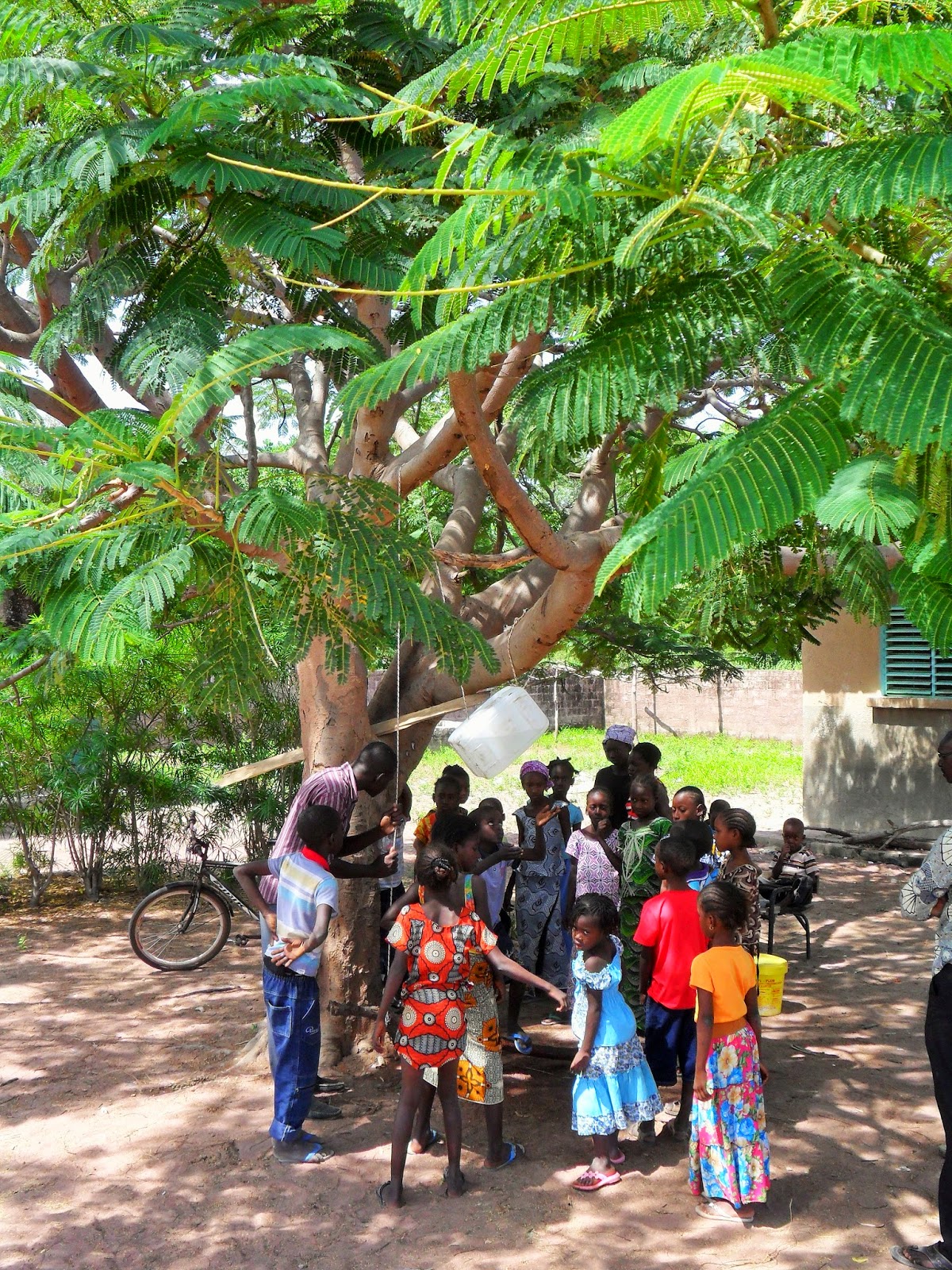
Then we went to the tippy-tap station outside the school, which I constructed under a picturesque Flamboyant. The kids first tried to wash off the glitter with water alone - no dice.  Then they tried it with soap, which was still only moderately effective, because glitter is devilish.


All clean!!!!!!!