Disclaimer

The contents of this Web site are mine personally and do not reflect any position of the U.S. Government or the Peace Corps.

Saturday, August 22, 2015

English Camp in Thies

I'm writing this while sipping iced cafĂ© au lait on a shaded restaurant patio in sunny beautiful Thies.  I left site and came up here to help with a weeklong English camp at Lycee Malick Sy, a local high school.  The camp ended yesterday, so my plan was to wake up early, pack up my stuff, corral my new garbage kitten Mallory, say goodbye to my dear friend Liz, and be to the garage early enough for Mallory and I to get the just-after-sunrise car to Tamba.

Mallory the garbage kitten is very studious and very adorable.
 She's my hail Mary to take down my hut rat.
I have no idea how she was a street cat; she's the friendliest kitten ever.
That plan did not happen.

There are absolutely no consequences for that plan not happening.

Peace Corps work is notoriously nebulous and hard to define.  I do not have a formal work supervisor in village, and the counterparts I do work with often only agree to help me because I dog them so aggressively.  The "work" I had to get back to village for was self-assigned and will still be there upon my return tomorrow.  To assuage my lingering guilt, however, I decided to write a blog about my week.  You are now reading that blog.  Thanks.

So, how did camp go?  Well, I don't know.  I think the kids had fun, but I don't know how much English they learned.  When I get blank stares in response to things I say in village, I usually assume my baby Pulaar is to blame.  This week, however, I got a similar number of blank stares while speaking my native tongue, as slowly and simply as I was able to.  Kids were largely unable to follow simple commands like "make a circle" or "stand in line," but they correctly spelled "decision" and "mythical" during the spelling bee, and knew "octopus" and "antelope" when confronted with badly drawn pictures of them.  It was baffling.

So the campers and I didn't really speak the same language, and we also didn't really have the same definition of what the camp should be.  Since it was only a half-day, from 9-1, with a half-hour break in the middle, Liz and I were trying to get the most out of every short minute.  I've happily embraced "Africa time" in village, but this was not village - this was a formally scheduled city camp, with students chosen for their academic potential, with set start and end times.  It was frustrating trying to compromise between a slow, viscous Senegalese culture and a tight, rigid American one.  Even though the campers did, miraculously, all arrive at 9, when the camp was scheduled to start, it took at least 15 minutes to get the first activity underway, and all subsequent activities also required several long minutes for the campers to slowly transition, as though all their movements were done in a vat of honey. 

Our Senegalese co-facilitators were wonderfully encouraging, perhaps to a fault.  A typical interaction went like this:

"Should we do the vocabulary game or the fill the bottle race next?"
"Yes!"
"Which one?"
"Whatever you want!"
"OK, how about vocabulary?"
"Yes! That's OK!"
"Is inside or outside better?"
"Yes! Whatever you want!"
"Outside there is more room."
"Yes!  Outside!"
"But it looks like it might rain."
"Yes!  Whatever you want!  It is OK!"

Eventually we just started leading the sessions on our own, which was fine, but not ideal because we didn't really know what we were doing or what the students' English abilities were, so we didn't know how hard the activities should be.

By the end of the week, we had it mostly figured out.  In case future English Camp teachers happen to be reading this, here are the week's most and least successful components.  Read and learn, because by camp time next year this girl's gonna be sippin' sangrias stateside and won't be around to help, suckas.

MOST SUCCESSFUL:
  1. Fixed teams.  We split the kids into four teams first thing, and had them design a flag and a cheer.  They kept these same teams all week, and we could see cohesion strengthening as the week went on.  At the end of each camp day, we formally tallied the day's points and updated the special scorekeeping chalkboard.  We also impulsively added or subtracted points for behavior, which helped with management and (bonus!) made me feel like Professor Snape.
  2. Themed races.  We did a three-legged race, fill-the-bottle race, egg spoon race, and dizzy race. Everyone participated, everyone laughed, nobody spoke any English.  Meh.
  3. Running captions.  I drew several crazy pictures (an elephant on a skateboard with a chicken in a spacesuit drifting overhead, a shark in a party hat eating a birthday cake, etc.)  Each team sent one person to look at the picture, then that person had to go back to their team and describe it.  The team had to submit a paragraph describing the picture, then we gave the team a score of 1-5, completely arbitrarily because we were flying by the seat of our pants and hadn't fixed any sort of scoring rubric.
  4.  Spelling bee.  Oddly, the entire group was so transfixed you could hear a pin drop.  When I said "That is correct" they all erupted in cheers; when I said "That is incorrect" there were audible gasps.  It was suspenseful.  The winning word was pineapple.
  5. Scattergories.  We did this as an impromptu last-day activity because we had an unexpected hour to kill, and everyone loved it so much we wished we would have done it earlier and on purpose.
  6. Hokey Pokey.  I think they mostly just liked this because they liked watching a Toubab dancing badly.
  7. Vocabulary Chain - We formed a circle and said a category, like "animals" or "vegetables" or "countries."  As we went around, if a student repeated an answer or couldn't think of one, they were out.  It was fun.
LEAST SUCCESSFUL:
  1. Charades.  The kids refused to act anything out, they just repeatedly mouthed the word while standing still.  The words weren't hard - dance, glasses, soccer, camera - so they were probably just embarrassed.  When Liz or I acted out a word, they happily guessed, but refused do it on their own.  Frustrating.
  2. Question Box.  The idea was to let the students write down a question for Liz or I on a small piece of paper, then for us to draw a paper at random from the "question box" and answer it.  The Senegalese teachers recommended this because they thought the kids would be too shy to ask questions in front of their peers.  Instead, we got questions like these: 
    Bottom left - no.  All others....man, IDK.  Does anyone K?
  3. Sketch prep.  The first two days, we gave the students 20ish minutes to work on sketches for the last day's group presentations.  Instead of working, the students either put their heads down and napped or flirted with and grabbed at each other. The final group presentations were random improvised hard-to-follow theater sketches, and I don't think that all the practice time in the world would have changed that.
  4. This is a half con.  The kids had to choose an English name the first day, but they had a tough time thinking of anything original, so there were two Beyonces, three Chris Browns, a Justin Bieber, and two Rihannas.  This was confusing (con) but adorable (pro.)  There was also a Barbara who chose to be named after me. 
    Barbara and Barbara.
     
So, seven pros and three and a half cons!  Overall, it was a really good week, and I definitely recommend it to any other PCV.   Here are obligatory cute pictures.


Thursday, August 13, 2015

Drawing Diarrhea!

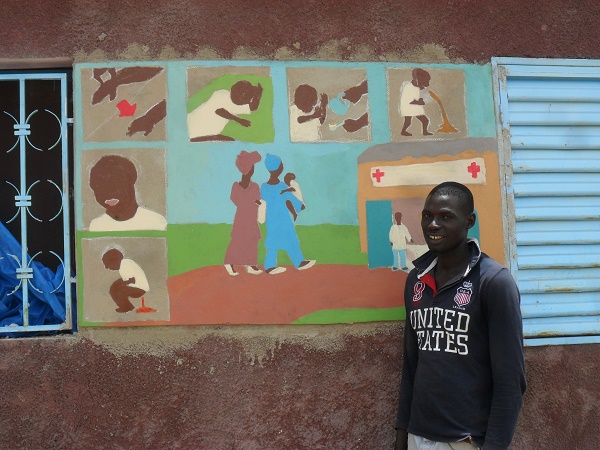
A month or so ago, I went to a meeting of the ASCs (Agents de santĂ© communautaire - local health workers, in English) and told them I was interested in doing murals at their sites.  I chose this project because my sitemate Lauren's a wonderful artist and I was looking for more opportunities to exploit her, and also because some of the health stuff we teach (the danger signs of diarrhea or severe malaria, how to care for mosquito nets) can be hard to explain to someone not used to a foreign accent. I thought that a mural would be a useful visual aid that the villagers could look back on for at least a few years, until Senegal's heat, wind, and rain wear the paint away. Six ASCs said they were interested, so I went to their villages and had long tea-fueled discussions about what they believed the greatest health threats in their village were. 

Three said diarrhea.  Two said malaria.  One said improper pesticide use.

Then I developed murals based on each answer.  By that I mean that I commissioned Lauren to draw them.

In exchange for receiving a mural, each ASC agreed to lead a causerie of 20-25 community members on their mural.

So far, Lauren and I have only done one mural - diarrhea danger signs, in Saare Sukande. I am hopeful the others will be done by the end of September.

Lauren is very busy with texting.


Beautiful.

Saare Sukande's ASC, Demba Balde, with his half-finished mural.  I don't have any pictures of the painting in-progress because filling in the lines was the one part of the mural that required no real skill, therefore the only part I could help with.


Me and Lauren and Demba, with the final product!


Danger signs from bottom left - blood in the stools, fever, when pinched the skin does not rebound quickly [which is a sign of dehydration], lethargy, refusal to eat or drink, vomiting.  Who but Lauren can make bloody diarrhea look this pretty?

Leading his causerie.

Update March 2016: 
I have a new camera!  Here are the rest of the murals:

Kountanto - danger signs of severe malaria

Kansatan - causes of diarrhea (five F's - food flies fingers fluid feces)

Complet model of nutrition
Danger Signs of Malaria, at the Saare Meta Health Hut


Sunday, July 26, 2015

Ode to my Cell Phone

If you’re an American reading this, you probably have a smartphone.  Smartphones are perfectly suited to the American way of life.  You can look up the closest Thai restaurant that offers a student discount, read reviews to choose what to order, place an order, and have your phone analyze satellite traffic to provide the most efficient route before giving you GPS voice guidance to drive there, all within 2 minutes.  In America, cell phones make life easier.
 
My cell phone makes my life easier in Senegal, too.  Though it could not be called “smart,” it is perfectly suited for my environment.

My phone is tough.  There are no carpeted floors here in my Pulaar village.  If you’re lucky, your hut floor is poured concrete – if not, it’s packed laterite.  Dropping an iPhone here could be fatal to it, but not to my brick!  There’s no touchscreen to crack, no sensitive camera lens to dirty.  I’ve dropped it dozens of times.  Babies have played with it like a hammer.  I’ve tossed it across the compound to my tokara when she’s asked to use it.  Though primitive, it’s been a tireless champ, the Nile crocodile of cell phones.

The battery lasts forever.  My brick never leaves my side.  I’m a texting fiend, and I talk on the phone far more than the typical villager.  Even so, I only have to charge it every few days.  Most people in my village get by with charging their phones once a week or so.  When the battery does need to be charged, it’s easy to do so.  Find someone with a solar panel, drop it off, and pay 100 CFA (about 20 cents) when you pick it up later.
My host brother Oussaman got a solar panel a couple months ago and he's been rolling in business.
It has a built-in flashlight.  Those of you that don’t understand how useful this is have probably never lived without electricity.  It’s really goddamn useful.
It has a built-in radio.  This is less useful than the flashlight, but still nice.  I can't get any channels on it in my village, but it would probably work in a larger city.  I've seen people with wire attached to their phones (like antennae) and headphone jacks in their ears, so presumably that works too.

The games are on point.  It came equipped with Snake, Rapid Roll, Cricket Cup, Sudoku, and Forbidden Treasures.  I still have no idea how to play Forbidden Treasures (ironic...) but the other games are great.  I favor Snake, but play the other games regularly too.  I probably never would have learned to play cricket if it wasn’t for my phone and my ample free time.  Hidden Peace Corps perk!
Looks like nostalgia...
 
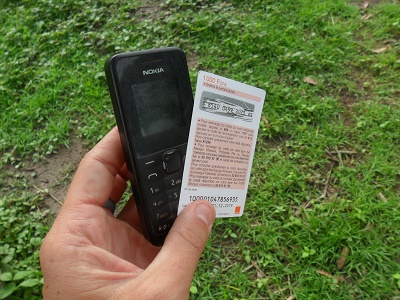
It's well adapted for a chronically broke person to use.  Cell phones here are recharged with purchased cards, each worth 1000 CFA ($2, but a lot of money in village).  The cards can be purchased from any boutique.  You scratch off the foil, type the numbers into the phone, and - voila! - you have about 30 minutes talk time. 


If you're broke, no worries - there are no monthly fees, no contracts, no mandatory scheduled payments.  If you can't afford credit and need to talk to someone, you can send them a text that says "Merci de me rappeler" (please call me) for free.  The text recipient will see the message and call if they have credit.  If your phone does have a fatal accident, it's easy to get by while waiting for money for a new one.  The SIM cards are removable and transferrable to any other phone.  One of my neighbors hasn't had a working phone for months, but she puts her SIM card in mine sometimes to greet her family in Mauritania.

It keeps me updated with other volunteers and admin. Text message alerts, called CPAs, come in frequently.  These messages are great for keeping all volunteers in the loop about grant deadlines, safety and security issues, or administrative updates.  They were especially useful during last year's Ebola epidemic.  It was good to know that if something happened involving Peace Corps' position in Senegal, we would all be notified at the same time instead of relying on diluted gossip through the rumor mill.  Volunteers also get free volunteer-volunteer calling, which is the best thing admin could have done for our mental health, in my opinion.  Not a day goes by that I don't talk to someone in my Peace Corps family.
You can send money with it.  I haven't utilized this feature, but it's been a lifesaver for my host family.  A Western Union style system called Wari is really popular here.  If you send someone a Wari, they just have to take their phone (with confirmation text) to a Wari station (they're everywhere, there's one 4k away from me), show the person working your ID, and collect your money.  It's so easy.
 
The computer, iPod, and tablet I brought to Senegal from the states have all fallen prey to the harsh environment here.  This is where electronics go to die.  I have a friend who's gone through two kindles, a camera, an mp3 player, and two laptops.  However, the brick cell phone is still as functional as the day I got it, and I'm thankful.

Monday, July 20, 2015

Rat Trap Blues

I woke up to fat, slow raindrops dripping through my shade structure and on to my face.  I scowled, half asleep, and groped for my cell phone (which, due to its built-in flashlight, is never more than an arm’s length away after dark).  12:42, it said.  I pondered whether I should move inside to sleep or whether the drizzle would stop soon.  In response, a thunderclap sounded and it started raining buckets.  Blah.

I stumbled inside, half-asleep, carrying my partially sodden foam mattress, my path dimly lit by my cell phone’s flashlight.  Something was wrong.  Several books were strewn across the floor, not on my table where I'd left them.  My shampoo bottle was laying on the ground, too, a small puddle of liquid pooled around its nozzle.  And – what was that? – oh yeah, the glue rat trap I’d bought in Thies was upside down on the floor, too.  As I looked, the trap suddenly clicked and scuttled towards me.

I shrieked and jumped.  “Oh god oh god oh god oh god oh god!”  After three kinds of rat poison hadn’t done the trick, I’d bought the trap hoping to catch the rat, but this possibility had honestly never occurred to me.  I thought if the trap did work, the rat would die instantly and peacefully, allowing me to sanctimoniously drop it in my latrine hole with a shrug and a silent apology (“Well, I’m sorry, but you did it to yourself, you know.”)  Unfortunately, the rat didn’t agree to that plan, and he wasn’t going down without a fight.


My heart was racing.  I cowered in my rain-drenched sleep shorts as I considered my options.
1.       Ignore it until morning and make my host brother deal with it.  Although this was the most attractive option, it was not possible.  It was raining too hard for me to go back outside, and I doubted the rat would sit still until daylight.  I wouldn’t be able to sleep with it running all over.

2.       Toss the whole mess outside, rat, trap, and all.  That would mean touching it, which there was no way I was going to do.  Rat scratch fever, Hantavirus, the plague…no.

3.       Kill the rat.  I didn’t want to do this, but I couldn’t think of any other possibility. 

I reluctantly strapped a chaco sandal on my right foot and breathed deeply, trying to get up the nerve to stomp the trap.  I wished I’d brought a nice thick baseball bat to Senegal for this occasion.  The trap was still now, which I interpreted as the rat silently and serenely accepting his fate.  I muttered encouragements to myself. “Come on, Barb.  You’ve got this.  Just do it.  You can do it.”

Five minutes passed, silent except for the wind and rain and my racing thoughts, completely dark except for my flashlight beam.  
I realized there was no way I’d survive a zombie apocalypse.  I knew I was being a baby, but I still couldn’t move.  It was just a rat! I reconsidered option 1, leaving the trap until morning.  As if it were reading my thoughts, the trap moved, scraping noisily against my concrete floor.  “Oh god oh god oh god oh god!”  I shuddered, closed my eyes, and stomped the chaco as hard as I could in the center of the trap.

But the rat was not in the center of the trap.  It was far off to one side of it.  The trap was also not very well made – its surface was slick, wet, and barely sticky at all, the masking tape of glues.  My stomp only served to slide the gluey cardboard off the rat’s back and onto his hairless tail.  He yelped, scared and angry, then limped away from the trap unencumbered, his fur shiny with wet glue.  I knew I should chase him.  I knew I wasn’t going to chase him.  I watched as he walked, fearlessly and purposefully, out my open back door into the rain.  Lightning flashed and – I swear – he looked back at me over his shoulder before disappearing into the tall grass, where (I imagined) he’d clean himself off, gather his friends, and prepare a counter-attack.

I tucked my mosquito net in very carefully, telling myself the thin gauzy fabric was ample defense against a revengeful rodent.  I eventually fell into a fitful sleep, had a mefloquine nightmare about Zombeavers, and woke up in a puddle of my own sweat. 

Africa: 1, Kadiatou: 0.

Saturday, July 11, 2015

Family Bonding.

"Konk Konk," said my favorite host sister, Meadow, from my open hut door.  I looked up from The Poisonwood Bible, smiled, and welcomed her inside.  We went through the normal round of greetings, ending when I asked what was new and she sighed and said nothing.  The visit wasn't unusual - it's Ramadan, and afternoons are boring.  There's no lunch preparation or afternoon tea to break up the day, and most people spend the afternoon napping. The village is a total dead zone from around 2pm until break fast around 7:30.  I'm not fasting this year, so many kids (who also don't fast) use "visit Kadiatou" as an afternoon activity.  I have some picture books brought back from America that kids are welcome to read as long as they don't remove them from my hut. Meadow picked up a book she'd already "read" many times and started turning the pages. Ten minutes elapsed - I forgot she was there.  The Poisonwood Bible is a very good book.  Finally, she spoke.

"Tomorrow, I might go to a dennabo (naming ceremony)," she said. 
"Yes, me too!" I replied happily.  Several people had told me about the dennabo already.  It was supposed to be a huge affair, with speakers and cold boissons biked in from Velingara in coolers. Usually, parties don't happen during Ramadan, but they made an exception for this one.  It was going to start right at break fast and continue well into the night. I was really looking forward to it.

Five more minutes elapsed in silence.  The Poisonwood Bible is a very good book.

"Aliou's washing tonight," she said nonchalantly.
I was fairly certain I'd heard correctly but had no idea who Aliou was or why she was telling me this.  "Oh yeah?  What we will he wash? Clothes?" 
"No, I said Aliou," she slowly clarified. "Aliou Balde."
"Awa," I said with a shrug.  OK.

Meadow didn't give up.  "Aliou Balde," she said again.  She pantomimed washing her hair.  I remembered that was the name of the man in town that washes womens' hair.  They just go to his compound and pay 200 CFA (roughly 40 cents) and he lathers them up.

"Awa," I said again.  The town hair washer, who washes hair every night, was washing hair that night.  That was a weird thing to tell me.  Must have been a slow news day in Teyel.

More time elapsed.  The Poisonwood Bible is a very good book.  Finally, I felt Meadow's stare piercing me through the pages.  I looked up and recognized the pleading look in her eyes.  Realization hit me like a beam of lightning.

"OH!  I UNDERSTAND!" I exclaimed. I was proud of myself for figuring it out but embarrassed that it took so long.  Meadow looked relieved.  I stood up and got a 200 CFA coin from my wallet to pay for Meadow to get her hair washed for the party. 

Then I decided to mess with her a little bit.  Like all big sisters, I'm kind of a bully.

"You will wash the hair until you're clean?" I asked.  I accidentally used lootde, to wash, instead of looteede, to get washed.  Reflexive endings are hard and I forget a lot.  Meadow didn't correct me like most 13 year olds would ("no, I'll get washed, dummy!").  She just politely said yes. 

"You have a friend there?" I enquired.  She just smiled shyly.  I kept digging.  "A boy friend?" I prodded.  Just like in English, "boy" and "friend," innocent when separated by a space, combine into a far more loaded word.  Sahel gorko could be nothing, a friend who's a boy, or a real boyfriend.  I said the words close together, in a way that was teasing yet kind (I hoped.)

Meadow put her head in her hands and laughed, embarrassed.  If her skin were paler, her face would be blushing beet red. 

"Now I understand!", I squealed, throwing my pillow at her.  "What's his name?"

We both laughed.  I waited for inspiring Full House theme music to bubble up, incited by this lovely heartwarming family moment.  Instead I heard only roosters and goats.

"Meadow," I said slowly.  "You will go to school next year."
She solemnly nodded.
"And the year after next, and three years from now." (This is easier to say in Pulaar - e ñatigaro, e Ă±atagaro)
I tried to make meaningful eye contact, but Meadow was looking at the door.  She had gotten her money and I was acting a little too much the nosy big sister.  She glanced back and recognized the pleading look in my eyes.
"Oh! Yes! School!  I will go to school," she assured me.
I kept looking at her.
"I will have girl friends only."

We laughed and said "let us spend the afternoon in peace" - a mouthful in English, but three simple syllables in Pulaar, ñallen jam. 

Monday, June 29, 2015

Minen? Doo? Ndeer Fuladu?

Behavior change is hard, guys.  I knew from the start that I'd be "not from around here" in my village, but I was hoping I'd be a respected foreign consultant whose accent adorably gets in the way sometimes (like a sexy doctor on ER.) Instead, I'm finding that I'm Fez from That 70s Show: nice, but weird.  Really weird.  You'd never take advice from him.

Pulaar is nothing like English.  It's full of symbolic language, idioms, and double meanings, and the words are in a shuffled order.  When my brain thinks in English, the Pulaar sentences come out twisted, like a crumpled banner, and it's my listener's hard work to straighten my crooked words to understand the message.  Of course, everything that I hear is also twisted, so I need to straighten the Pulaar words I hear into something that makes sense to my English brain before I can understand.

I don't want to sound negative - I'm not.  I'm having a lot of fun with this!  It's the ultimate brain teaser.  If I have a patient listener, I can have whatever conversations I please, and thankfully this is a small enough town that a lot of people have nothing better to do than to talk to me.  I know it will get even easier my second year here, and that's exciting and inspiring.

However entertaining Pulaar Puzzling may be, it does stand in the way of my behavior change goals.  After all, I did come here to work.  Unfortunately, I'm not yet too convincing when I try to have complex conversations analyzing the pros and cons of new vs. traditional practices.  Usually, my friends in village just shake their heads at my weird, foreign ways and say "Minen, doo, ndeer Fuladu..." (we, here, in the Fuladu [Pulaar-speaking region]), then explain what they do, slowly and clearly, as though they were talking to a child.  After all, in their eyes, they're the normal ones.  I'm the odd duck.

I started keeping a list in my notebook of all the times I've heard, "Minen, doo, ndeer Fuladu...." used to explain a completely perplexing behavior.  Each time, my language was sufficient to mutually understand each other, but we both left shaking our heads in bewilderment.

 We, here, in the Fuladu...

We think that morning coffee purges witches.

"Kadiatou, buy me coffee."
"Haha, my uncle!  I am without 5 CFA this morning.  I am not drinking coffee today."
"You will drink coffee at home?" (think - a "yes" means that this random dude might invite himself over, and I don't want to deal with that.  A "no" means a possible lecture.  Decide to go with my old standby, the noncommittal shrug.)
"In the night, vampires and witches can come.  They enter your body.  In the night, it is cold.  You must drink hot in the morning."
"Ah, because witches aren't used to hot?  They can't hot?" (woowde and waawde, "to be used to" and "to be able to", sound similar and people sometimes can't hear the difference through my accent, so I decided to say both just to cover my bases.)
"Voila."
"In the old place, (said to refer to wherever us Toubacos are from, because no one can remember if  we're from France or America or Italy or Spain, and it's all the same anyway), we drink coffee because we like coffee."
"Well, we here know that coffee is important.  We, here, in the Fuladu, we think coffee is medicine."

We think honey cures diabetes.

"Kadiatou, you will drink?"
"What is?" (In Pulaar, you just say hoko woni, "what is," instead of "what is that."  I don't know why we say the "that" in English.  It's an unnecessary syllable.  If it's not obvious what "this" or "that" is through context, the word "this" or "that" doesn't provide any clues as to what you might mean.)
"Honey.  Woods honey."
"Oh!  I will drink a little."
"Drink it all!" (she in no way expected me to drink the entire liter cup, that's just the polite thing to say.)
"If I drink it all, I will have gotten diabetes." (I was trying to use the subjunctive, which is hard grammatically.  I wanted to say "if I were to drink all of that, I would get diabetes" but I spoke weird nonsense instead.  She looked confused for a second, then lit up, thinking she understood.)
"Yes! If you have diabetes, this cures you."
"...no."
"Yes!  This is medicine for diabetes.  If diabetes catches you (In the Fuladu, diseases catch YOU instead of the other way around), this is medicine."
"...No.  When diabetes catches you, your body can't sugar.  Honey is sugar.  Drinking sugar when your body can't sugar is bad."
"This is not sugar. This is medicine."
"Honey has vitamins a little, but it is not medicine for nothing. (double negatives are grammatically correct here).  It is not good for diabetes.  It is sugar really really."
"Well, we? Here? In the Fuladu?  We think this is medicine for diabetes."

We think powdered milk is medicine.

"Adama!  I heard you are sick."
"I'm a little better." (Even if you're on death's door, you always insist that you're a little better.) 
"What got you?"
"A cold."
"You got hospital medicine?" (there are other ways to ask questions, but the easiest is just to pronounce a statement like it's a question, so that's what I always do.)

"No, I drank Vitalait."
"Vitalait?  The powdered milk from the boutique?"
"Yes.  It is medicine."
"Vitalait is not medicine.  Amadou Dem (the boutique owner) is not a doctor."
"It has vitamins.  It is medicine.  We here in the Fuladu think it is medicine."


We plant hot peppers in the rainy season.

"Lumbi, you are going to the field?"
"My garden, there."  (She said a short, clipped "to" instead of a longer "tooooon," meaning the garden was not far away.)

"Ah.  You are planting?"
"Yes."
"What you are planting."
"Hot peppers."
"Remember last year you planted hot peppers?"
"Yes, last year I planted hot peppers."
"Remember when you sold your harvest, you got money very small.  Because everyone, all the people, sold peppers at the same time."
"Yes!  I didn't get money."
"This year, you can grow tomatoes or eggplant."
"I grow hot peppers in the rainy season."
"But everyone grows hot peppers.  No one grows tomatoes.  If I woman grows tomatoes, she can get money.  Because everyone grows hot peppers."
"Yes.  We, here in the Fuladu, we grow hot peppers in rainy season.  Hot.  Peppers."  (Similarly, everyone sells mangoes during hot season, and peanuts during dry season.  Everything is bought and sold at the same time as all the neighbors are buying and selling the same thing.  Sellers are constantly complaining about the low prices their wares are getting.  Buyers are complaining about the high prices they have to pay.)

We don't eat our chicken's eggs.


"Tidiane, do you eat eggs?"
"Ha!  I'm not a patron, I don't have money for eggs!"
"You have money.  And you have chickens."
"Yes!  Lots of chickens!" *low whistle*
"If a chicken does an egg, (who knows the verb for "to lay"?), you take the egg, you eat it?"
"No.  If you sell one egg, it is 100 CFA, but if you sell a chicken, you get 2000 CFA"
"But it helps your body to eat eggs, and Pulaars say 'Health is the Largest Treasure.'" (memorizing a bunch of proverbs is one of the most worthwhile things I've done here.)
"You can Pulaar!  But we don't have money."
"Chickens here are many, but their food is not many.  It is not possible, all eggs are chickens.  Many die."
"Yes, many die."
"If you have 10 eggs, you can eat nine eggs.  One egg will be chicken. Food is enough for one only."
"We, here, in the Fuladu, we don't eat our eggs.  We sell our chickens."

We think that mirrors attract lightning.
Whenever dark clouds roll in, someone yells at me to remember to put a sheet over my water filter before the storms come or my hut will get struck by lightning and burn down.

We think that cat fur causes tuberculosis. 
If a cat hair gets caught in your throat, you will cough and cough until you die.  This is the leading hypothesis for what killed my dog while I was on vacation.  A close runner-up is that he ate a magpie. 

Wednesday, June 17, 2015

Let's Talk Toilets!

Late last November, I did a latrine project with Steph, one of my sitemates...read her blog about it here, if ya wish.  Steph and I, along with our Senegalese counterpart, Demba Balde, wrote a grant and purchased materials to construct 15 latrines in the villages of Goundaga and Lengewal, then conducted a latrine care/handwashing training.  The project went very smoothly, so when Demba approached me about doing a similar latrine project, building 12 simple pit latrines at 12 different residences in a nearby village called Saare Kutayel, I accepted (Steph was busy with other work and couldn't help out with this one).
 
This was probably the easiest thing I've done in Peace Corps.  Demba handled all of it promptly and efficiently.  My job was to write the grant, deliver the money, collect the receipts (all clearly written for exactly the amount I'd budgeted) and conduct a handwashing/sanitation training.  Demba took care of finding the mason, delivering the supplies, keeping everyone to the schedule, informing the heads of households about the trainings, and helping me Pulaar during the whole process.  It was a breeze.

The grant funds covered cement and steel rebar to put inside the cement to strengthen it.  The grant recipients dug their own holes using only rudimentary hand tools without remuneration, no easy task in an area where the lifeless sun-baked goat-trodden ground hasn't seen rain in over six months.
 
 
The mason Demba hired was lovely.  He was polite, hardworking, and prompt, and honest throughout the entire process.  Here he is helping one of the latrine recipients set the cement for the cover to their latrine.
 
 
When the cement slab was dry, it was simply moved over the hole.  Done!  New latrine.
Demba insisted on taking this picture...awkward.
A week after the latrines were finished, I conducted a latrine care/handwashing training under a mango tree in the village.  All latrine recipients were required to attend, and I strong-armed a couple PCVs (Corin and LK) into attending as well.


I'm having a serious love affair with flip charts lately, so I utilized one during this training.  I drew a picture of a latrine, then had several other cut-outs that I taped on the latrine picture to talk about what does and does not belong in a latrine. 
 
Review: Poop, both child and adult, goes in the latrine.  Garbage, sticks, and rainwater do not.  Flies also should not go in the latrine, so keep the hole covered.
Then we moved over to the chief's house for the handwashing component of the training.  I had gone to the site early to help make a tippy-tap (or yapsoodo, the Pulaar name that Demba gave it.)  Everyone practiced using the device to wash their hands, then we discussed why it was more sanitary to use a device like that rather than washing one-hand-at-a-time with a plastic kettle. (If you wash one hand at a time, germs go from the dirty hand to the kettle handle to the "clean" hand, so after washing you're still not clean.)
 
 
That's it!  Everyone sat around and drank tea while waiting for lunch, I gave them soap and rope to make their own handwashing stations, then we all went home.  I'll be going back to the village in a couple weeks to see if anyone actually constructed a handwashing station and to ask questions about the latrines.     

So...was this a successful project?  I keep going back and forth about whether I'm proud of it or not.

Demba, my counterpart, has ambitious plans for me to do a latrine-a-palooza in the next dry season (October-November or so.)  He has a list of 82 more households he wants to build latrines for. 
 
Should I do it?
PRO
CON
 1) It would be easy.  Demba did 95% of the work for this project.  The large-scale latrine project he's proposing would probably be my best opportunity to do a big project in Senegal.  After all, I only have 10 months left.
1) I feel exploited.  Demba has a long history of using Peace Corps volunteers to fund his projects - there was another latrine project done in Goundaga in 2011, and probably even more before that.  Sites are supposed to be closed after three generations of volunteers, and Demba has already had four, not counting me or Steph.  He should technically be cut off.
 2) This is a chance to increase health and sanitation for 82 households.  It fits clearly into my project framework, the Peace Corps document that tells me what I'm supposed to be doing here.
 2) None of those 82 households are in my village, which might lead to resentment.  I haven't pursued latrines in my village because no one has approached me asking for them (so I didn't see a perceived need), but at the same time, if people in my village see others getting a latrine, they might demand to get one, too.  Jealousy hurts.
 3)  It wouldn't be a problem to fund it.  I posted the original latrine project grant (~$500) right before I went on vacation, hoping that if friends or family wanted to donate to my work they could just donate to the grant.  Instead, it was fully funded by strangers within two days of posting. 
 3) I'm not sure it's a great use of money. After all, literally thousands of years ago, the romans had aquaducts to supply their toilets with running water.  Why, in 2015, do people here still need someone to pay for a hole to poop in?  If it were perceived as a real need, I think they might have found a way to pay for it themselves by now.
 4) The community members who would be receiving the latrines are willing to pay a fairly large contribution (2000 CFA) and to attend a series of water, sanitation, and hygiene trainings, in addition to doing all the unskilled labor (digging the holes, transporting the materials with a donkey cart).
 4) Same as above.  I am probably the 500th person to try to teach water and sanitation practices here.  I don't think lack of knowledge is the problem, and I'm not sure if trainings would help.
 5) I have the time.  I do much more work here than I used to, but less than I did in the states.  It'd be nice to feel busy again.
 5) If I'm busy with a large-scale latrine project I might not have time to do other work in my village.
 6) The proposed sites for the latrine-a-palooza are in the "red zone," where volunteers currently cannot serve due to safety and security concerns.  That means that no Peace Corps volunteer will be posted there in the foreseeable future, so if I don't do this project, I don't know who will.
6) USAID, Unicef, WorldVision, Adamas, Water Charity...if I don't build these latrines, someone else probably will.  And if a new organization keeps swooping in and building latrines every couple years, there's no reason for cmmunity members to take initiative to build their own latrines.  Why buy something if you know you can get it for free if you just wait awhile longer?

So...what do you think?  I've been thinking about this for over a week and I'm still not anywhere close to making a decision.  I'd love some inputs.