Disclaimer

The contents of this Web site are mine personally and do not reflect any position of the U.S. Government or the Peace Corps.

Tuesday, June 16, 2015

Michelle Sylvester Scholarship 2015-2016

It's that time of year again! 
 
Some of you might remember that one of my first projects last year was the Michelle Sylvester Scholarship, a Peace Corps program to pay the school fees for nine smart, motivated girls at my local middle school.  I am pleased to announce that I, along with my lovely sitemate Alice, will be doing the program again this year. 

If you choose to make a donation (instructions are at the bottom of this post), here are the girls at the middle school in Teyel that you'll be supporting.  They're really excellent kids - I wish you all had the chance to get to know them.
 

6eme – (equivalent of 6th grade)


Dado Diao is from a village called Saare Konkong, but she lives in Teyel during the school year with her grandparents.  Since she's a young woman, she's expected to help her grandmother and her aunts with all the housework.  Of the 15 children in her family, only five currently attend school - most of the rest dropped out at the elementary level.  She likes French and wants to be a middle school French teacher when she's older. Ami Sabaly, one of last year's MSS girls, is her best friend in Teyel and they frequently study together. 
 

Mariatou Sabaly has ambitions of becoming a midwife to help women give birth.  There are eleven children in her family, eight of whom go to school.  She said her parents are proud of her for getting a scholarship, and they are happy they do not have to struggle to find money for her fees this year.  Mariatou's older brother studied through 4eme before he dropped out, and he helps her with her lessons in the evenings. 
 
Malado Kamara is the only girl who mentioned how important her religion is to her.  She prays five times a day, like most practicing Muslims, and three of her brothers left home to be Koranic students (talibe).  There are currently 12 children in her family, but one of her brothers died of a "stomachache." Perhaps because of this, Malado wants to work in medicine.  Malado has a strong female role model at home - her mother, Fatoumata, sells beauty supplies at a weekly market nearby, and paid for her daughter's inscription fees last year out of her earnings.  In this unabashedly patriarchal culture, it was nice to hear of a strong woman prioritizing her daughter's education. 
 

Sido Boiro is only twelve years old, and she got the highest grades of any girl in CEM this year - 16.9.  (Note: A Wikipedia article about academic grading in France and French schools can be found here.) When Alice and I met with her at her house, we were amazed at how much work this amazing young girl does.  Turns out that her father (Mahamadou) was an only child, so when he and his two wives moved to a fishing town near Dakar called Joal, no one was left at home to help Mohamadou's mother with all the cooking, cleaning, and childcare that defines a woman's life here.  Mohamadou sent his daughter Sido, along with her three younger brothers, to help her grandmother out at home.  Since Sido is the only young woman at home now, she is responsible for washing clothes, doing dishes, pulling water, pounding grain, preparing meals, and taking care of her brothers.  I asked her, flabbergasted, how she had any time to study.  "I don't," she replied flatly.  "I can't study.  Other kids play at school because they know they can review their lessons later.  I can't do that.  Whatever my teacher says, I must listen so I remember."


5eme (equivalent of 7th grade)

Adama Tely Balde is the only 5eme MSS scholar who did not receive the scholarship last year.  She also has the biggest family of any of our girls this year - between her father's three wives, there are 22 children total.  Not surprisingly, she says that she can only study inside her hut, since when she's outside the kids bother her.  When she's inside, however, there's not enough light to see well, and the family has trouble finding money for flashlight batteries.  Every rainy season, Adama Tely goes to her sister Hadia's house in Velingara (a city 15k away) to clean, cook, and take care of her nieces and nephews.  She says Hadia regrets leaving school, and Hadia frequently tells her little sister Adama Tely to avoid men until she's completed her education. 


Last year, Adama Balde said she wanted to be a doctor, but now she says she wants to be a French professor.  She prioritizes studying - she said if she has to cook dinner (which she does every other night) she will get up early the next day to review her lessons before school.  Her father grows corn, millet, and peanuts, but does not sell any of his crops, so there's little money to pay for school fees or supplies.

Housseye Mballo says if she wouldn't have gotten the scholarship, she couldn't have gone to school this year - usually, her tokara (namesake) pays her inscription fees and school supplies, but this year her tokara, like many people in our area, was broke due to a bad harvest.  Last year, Housseye said she wanted to be a professor, but now she says she wants to teach English at a middle or high school. Her older brother works as a bike mechanic, and she says when he left school, her parents yelled at him, and she knows if she tried to leave, they would yell at her, too. 


Mariama Sabaly is now 16 years old and will be a 4eme student next year.  She says French is her favorite subject.  Her father, a farmer, has twelve kids, eight of whom currently attend school and two who dropped out.  I asked Mariama how her father was able to pay school fees for so many students at the same time, and she told me they grow a lot of cotton in her family, and her father doesn't mind paying the fees, since he sees education as a good investment for the future.  She's interested in being a doctor, nurse, or midwife, but hasn't decided which yet.

4eme (equivalent of 8th grade)

Djenabou Balde is another repeat MSS scholar.  She's 15 years old now, and still walks the five kilometers from her village to the school, an hour each way, in the blazing Sahel sun.  Her favorite subject is math, because she says it comes easily to her - she understands it without having to think about it too much.  She wants to get a job at the hospital in Velingara (15k away) when she finishes her studies, since she is familiar with the area and will be able to see her family regularly if she's close.  She studies from 9-11 most nights, before getting up before the sun to walk to school in time for her 8 AM class.

TO DONATE:

1) Please follow this link: https://beta.peacecorps.gov/donate/fund/senegal-country-fund/ and choose your donation amount.  Any amount helps, no matter how small!
2) Enter your personal information
3) Under "Please use this box if you want to send a message of encouragement to this project's volunteer" please enter "PC Senegal MSS Fund"

Please note the donation process is different this year than last year.  This year, donations are not made towards a specific volunteer's site.  Rather, the 2015-16 school year will be funded through the Global Fund and any excess funds will be put towards next year's MSS program.
 
Thanks for reading, and thanks for your donations!


Saturday, June 6, 2015

Pulaar Movie Nights, Part Deux

Senegal did unfortunately kill my movie-watching tablet - the annoyingly bold rat that disagrees with my inhabitation if HIS room (jerk) was running on one of my shelves and knocked over a plastic container full of sugar (jerk!), which then fell onto the tablet which had been resting on my table, cracking the only part of the screen that wasn't already cracked.  I wasn't willing to give up on movie nights - they're one of my favorite things to do at site at this point - so I started using my laptop instead.  Since the laptop doesn't have as much battery life as the tablet, we can only watch movies a couple times a week now, but the screen is so much bigger and the sound is louder, so my family says they prefer it this way.  I'm not ready to forgive the rat, though.  Please eat your poison and die already, jerk rat.

Pitch Perfect: The kids were talking and fidgeting during the beginning part of this movie (before the performances really got underway) but everyone stopped, as if on cue, for the musical numbers.  They were all spellbound by “Cups” (as most Americans were) but when I asked if anyone wanted to learn it the next day, they all said, “Mi waawaa! (I can’t!)”  I would recommend that other volunteers use caution if they want to show this movie. Audrey’s puking wasn’t a problem…they’ve seen grosser.  My aunt just asked, concerned, why she didn’t go see a doctor, because that wasn’t normal.  However, all the lesbian stuff was awkward, particularly the scene where Amy gets hit by a burrito and Cynthia performs unnecessary mouth to mouth.  It wasn’t the right time to have a frank discussion about how in America sometimes girls love girls.  I just shrugged and said I didn’t understand that scene.  It was uncomfortable. 

Beauty and the Beast:  This one was a hit.  It was a simple enough concept that I was able to explain it with my baby Pulaar, so it was one of the few films we’ve watched that everyone completely understood.  Since Senegal is a francophone country, everyone knows basic French greetings, so that first song (Bonjour! Bonjour! Bonjour!) was a hit.  As “Tale as Old as Time” (the somber, serious slow-dance song where Beauty and the Beast fall in love) started, everyone started giggling.  I asked what was up, and my sister said the animal (Beast) was wearing pants.  I thought I was missing something because the giggles persisted the whole 2 minutes of the song, but apparently it was just that funny.  They kept repeating, "laar tuuba makko!" Look at his pants!  I noticed with irritation that Belle didn’t actually eat anything during the Be Our Guest song, she just clapped and went back to bed. COME ON GIRL, you're surrounded by French chefs trying to feed you and I'm in the land of leaf sauce!  I am sadly obliged to report that my confusing shame-lust on Gaston has not abated with time, despite the fact that he's a narcissistic jerk bag. 

Finding Nemo: I had a French audio track to this one.  I had French for Aladdin, too, but Aladdin was too difficult for anyone to understand so it just as well could have been English.  Finding Nemo was good in French, since the characters spoke slowly and used simple words.  I barely speak French and I could understand some parts. My sister Medo, who studies in middle school, said she understood most of it.   Although this doesn’t have a reputation for being an educational movie, my family definitely learned from it.  I don't think many people here have ever seen a sea turtle, jellyfish, seahorse, whale, aquarium, or scuba diver.

Hook: We watched this movie over two days, and on the evening of the second day, my brother Alpha asked, excitedly, “Can we watch Rufio tonight?!”  All the preteen girls were also totally infatuated with Rufio even though they couldn’t understand a word he was saying.  When I asked who was more weydi (beautiful), Rufio or Jack from Titanic, two of my sisters started bickering so intensely one slapped the other.  The movie was too hard to fully explain, so I didn’t try – I just said that Hook took Peter’s kids, so Peter had to go to Rufio’s formation and learn to fight to get them back.  The scene where Julia Roberts gets really big and kisses Peter was weird.  No one here understood it and I guess I didn’t, either.  Besides Rufio, the most popular part of this movie was where Peter falls in the ocean and gets rescued by mermaids.  No one know what to think of them – weird beautiful fish-ladies.  I guess they are kind of confusing if you’ve never seen one before.

The Parent Trap:  I could explain this concept pretty easily – there were twins whose parents divorced, and each parent took one twin, then the twins met and switched places.  The beginning, when the girls meet at camp and dislike each other, was funny, but I did feel ridiculous for coming from a culture where spreading honey all over a sleeping child as a prank is possible (honey is like gold here, protected and savored). I also told my family that the camp the girls met at was a kind of special school, because I felt silly coming from a culture where people send off their kids to play for months each summer instead of relying on them for house or farm work.  When the dad’s new girlfriend came into the picture, I had to explain why that was a problem and why the girls needed to break them up.  In America, you can only have one wife.  In Senegal you can have four.

Spirited Away:  This one only lasted one night.  I told my family that I wanted them to watch films from the whole world, not just from America.  Since a major part of watching movies here is everyone narrating the events that are happening on-screen, anyone that happened to be walking by during this movie would overhear some really weird conversations. “Oh…the mud man is very smelly…oh…now the small child removed a bicycle from his back…”  My family didn’t want to continue watching this a second night.  I said if they didn’t watch it they wouldn’t know if the girl’s parents stay pigs or if they turn back into people.  It was not enough bait to change their minds.  They said it wasn't bad...they just didn't want to watch it. Lesson learned: abstract anime does not translate well to Pulaar subsistence farmers. 

Iron Man:  This unseated Jurassic Park as favorite movie for teen/adult males.  The afternoon after watching this movie, little boys in the compound were pretending to blast each other with their nonexistent palm-light-weapons, and my brother Alpha kept telling me, "Tony ne welli!"  Toni is also the Pulaar word for "lips," so I was pretty confused about why he was telling me that lips were cool, until he pantomimed flying and said "Tony" a few more times.  There was a somewhat graphic sex scene in the beginning of this movie with a rando who was clearly not Tony's wife (awkward!), which I tried to excuse by saying Tony was a bit of a kalibante (troublemaker).  I think this just made all the men like him more.

Avatar:  It was interesting watching this as a Peace Corps Volunteer.  I was strangely jealous of Jake Sully's "service" - why the hell did Neytiri and Mo'at speak English?!   He had it so easy! I hoped that my family didn't expect me to integrate into their community as well as Jake did into his.  I'm not going to marry a local and join in a war against my own people.  Sorry.  The family liked the movie, especially the big fight scene at the end of it, but the computer graphics might have been too good - there was some bickering about whether the animals in the movie were real or not.

Shrek: This movie is mostly dialogue between Shrek and Donkey, which no one understood, coupled with funny references to fairy tales which my family also did not understand.  All the physical humor was appreciated, though, especially Shrek's smackdown of the knights when he went to visit Lord Farquad and Fiona's smackdown of Robin Hood's merry men.  Even though the kids didn't understand what Donkey was saying, they still thought he was funny, but I don't think it would be worthwhile to watch this again.  There were too many scenes with not enough action.

Friday, May 29, 2015

Village Food

Ajaaraama!

I've been maintaining this blog for over a year, but I haven't posted much about Senegalese food yet, and that is probably the most frequent question I get.  So, hopefully this will rectify the situation.

 BREAKFAST:

I always buy my own breakfast from a vendor on the main road in my town.  This 1) gives me a chance to pump some money into the local economy and 2) lets me set my own schedule for the day - I can eat at 7 if I'm feeling ambitious and want to crank out some projects before the sun gets too hot, or I can eat at 10 if I'm feeling lazier.  I usually buy breakfast from my aunt, also named Kadiatou Sabaly.  She has bean sandwiches and café touba, which is like nescafe with cloves and other spices added.
 
Kadiatou with her bag of bread and bowl of beans.  I offered to retake it since her eyes were closed, but she insisted it was a good picture and she looked great.


A neighbor kid, Moussa, eating his breakfast sandwich.
If I don't feel like beans, I get mooni, which is little balls of millet in a thin sauce.  It's really good if you add sugar and milk to it.

Asi selling mooni, with her happy customers.

My mooni bowl, with sugar and kosam (fermented milk)

LUNCH:
 
I almost always eat lunch with my host family.  I share a bowl with my brother, Tidiane, and his son Mawdo.  Lunch is always corn, rice, or millet, with different sauces.  It's repetitive, but there's enough variety that I don't get too sick of anything.
 

Ceeb (fried rice) with bitter tomato and cabbage.

Rice with maafe domida (a tomato-based sauce).

Kodde (coarsely pounded steamed corn) with maafe girte (peanut sauce) and untu (fish balls - fish balls are also called "bara bara," which is endlessly amusing to my family since it means my English name, Barbara, is "fish ball.")

Sometimes you get lucky and get a fish head instead of a fish ball.

Rice and follere (a sauce made from hibiscus leaves)

Futi (coarsely pounded corn, steamed with okra and palm oil)
Ñankatan, the dish I named my dog after.  It's coarsely pounded peanuts mixed in with rice and onions, with some spice called oji added.  I have no idea what oji is but it's pretty good.  The vegetable is a bitter tomato.  They're not good but they're high in iron so I try to convince my family to buy/eat them.

Kodde follere
Rice and a palm-oil based sauce
Rice, some kind of meat, follere, and a piece of carrot

 
DINNER:
 
Dinner has less variety than lunch - it's always either lecciri or gosse, both of which are shown below.  I loved lecciri at first, then grew sick of it, then loved it again.  Currently I love it.  Every day around 4pm I get happy because I remember I get to eat lecciri in just a few hours.
 
Lecciri (finely pounded steamed corn or millet) with a watery sauce, called jammbo.  Usually the sauce has finely pounded peanuts in it to thicken it up and sometimes there are beans or leaves in it too.  The sauce is poured over the lecciri, which sucks it up like a sponge.  It's really good.
 
Gosse (rice cooked in too much water for too long, so it's like a thin porridge.  Salt or sugar is added to taste.  I sometimes add cinnamon, too, but my family thinks that does not taste good.
 SNACKS:
A handful of times, my brother Oussamon has come back from the woods with a bucket full of honeycomb.  It's wonderful.


Before the mangoes were ripe, people would make this concoction - pounded mangoes, salt, hot peppers, and MSG seasoning powder.  It sounds weird, but it was really good.  It reminded me of gardettoes.

 
I'm still averaging three mangoes a day.  They won't run out for about a month yet.

That's it!  Any other questions, please don't hesitate to ask.

Love, Kadiatou.

Sunday, May 24, 2015

Hercules, in Baby Pulaar

I’m back safe in stifling sweaty Senegal.  It was great to return “home” after my long American vacation.  I came back to a barrage of handclapping, dancing, and children and adults all running to me screaming “Kadiatou’s back!  Kadiatou’s back!” America was really hard to leave, as I expected…but after a village homecoming like that, I was happy to be back here.  Plus, the mangoes are ripe.

After I came back, one of the first things I did with my family was watch Hercules (the 90s animated film, not the Kevin Sorbo masterpiece, regrettably.  If anyone could send me files of Kevin Sorbo or Lucy Lawless, I’m down.)  I was able to explain most of the film using my baby Pulaar…sort of.

I’m far more comfortable speaking than I used to be, but my language is still laughably bad.  It’s like every day I’m working on a 1000-piece puzzle, but I only have 200 pieces.  I’m able to put together pieces that my village can recognize as coherent thought, but sometimes my paltry vocabulary and terrible grammar just doesn’t cut it.  However, even though there are many, many things I don’t know how to say, I’m getting much better at stringing together words I do know to explain myself, so if I have a sympathetic listener, one who is patient enough to work through the puzzle with me, I can get a lot across.

As you read through this, imagine that everything Kadiatou (me, the foreigner) says is in a very strong accent that makes her nearly impossible to understand, and that every 4th word or so has some grammar mistakes.

CHARACTERS:


Kadiatou, The Foreigner, Yours Truly.
Alpha: My 12-year old brother with a heart of gold.
Psydu: A teenaged neighbor boy who didn’t make much of an impression on me at first, but now that I can understand him, he’s hilarious.
Fatou: 14ish sister who is sassy but sweet.

*Credits Roll and Opening Song Plays*

Alpha:  “Kadiatou – is this film scary?”
Kadiatou: “No.  It is a film for children.”
Alpha: “Are there dinosaurs?”
Kadiatou: “No dinosaurs.”
Alpha: “I still see dinosaurs when I try to sleep at night.  The dinosaur film was too scary.”
*general exclamations of agreement, discussion of Jurassic Park*


Fatou: “Kadiatou, who is that?”
Kadiatou: “That young man?  He is called Hercules.  His father is Allah.  But there are many Allahs.  Those animals stole him.  Hercules drank the ‘magic’ drink.”(I stumbled on the word “magic.”  When I don’t know how to say something in Pulaar, I usually just say it in English with a French accent.  More often than not, this actually works.)
Fatou: “Le boisson magic?”  (Yesssss, worked again!)
Kadiatou: “Voila, le boisson magic.  But he did not drink it all.  Now, he is between man and Allah.  His mind is man but his body is Allah.”
*Hercules goes to Zeus's temple*

Kadiatou: “This is the mosque.  That is Hercules’s father, Allah.  He said that Hercules must get the personality and body of Allah.  Then he can come home.”

*Pegasus enters the screen*

Alpha: “Kadiatou, what’s that?”
Kadiatou: “Umm…puccusonndu.” (“horsebird,” literally).

Alpha (confused): “Puccusonndu?”

*rumbled sounds of disagreement and confusion.*

Fatou: “Oh!  I see!  Puccusonndu!”

*general happy grunts of agreement*


Alpha: “Kadiatou, what is that?”
Kadiatou: (hesitates for a minute...how do you say "satyr" in Pulaar?  Decides to let them answer this one on their own.) "You see.”
Fatou: “Mbeewagorko.” (“goatman,” literally.)
Alpha: “Kadiatou, is that an mbeewagorko?”
Kadiatou: “Yes.  His head is man.  His body is goat.  He is a teacher of fighting.  Now Hercules will learn fighting.  Now he has the body of Allah, but he cannot go home yet, because he does not have the personality of Allah.”

*first scene with Megara*

Psydu: “Who is that little girl?”
Kadiatou: “She is a woman.  Is she pretty?”
Psydu: “She has no body.  She needs to eat more mangoes.”

*Megara goes to Hades*

Kadiatou: “Now the woman is going to her boss.  You see, her boss is not good.  Now the woman loves Hercules.  And Hercules loves her.  Hercules gives his power.  Now Hercules does not have power."
Psydu (quietly, as if to himself): “When she goes to the doctor, he tells her to go weigh herself at the boutique instead.  She is less than 5 kilos!”

*The titans start attacking*

Alpha: “Kadiatou, turn the film off, it’s too scary.”

Kadiatou: “Just wait.  It is a film for children.  Everything is at peace.”
Alpha: “But Hercules does not have power. He will die.”
Kadiatou: “Just wait.”

*Pillar falls on Megara and she dies*

Kadiatou: “Now the woman died.”
Everyone: “She DIED?!”
Kadiatou: “Now Hercules has his power.”
Psydu: “Oh!  Because the girl was a witch!”
Kadiatou: “She was not a witch.”
Psydu: “Yes, she died, and now he has his power.  She was a witch.”
*Everyone agrees with Psydu, so I shrug and drop it.*

*Hercules dives in the pool of souls in Hell and rescues Megara’s soul and returns it to her body, which apparently was easy for everyone to understand because everyone happily narrated it to each other as it was happening.*

Kadiatou: “Hercules wanted to help his friend.  He did not think of only himself.  Now he has the personality of Allah.  Now Hercules can go home.  But the woman is only a person.  She cannot go to Allah’s house.”
Psydu: “She can’t go in because she is a witch.”
Kadiatou: “She is not a witch.  But now.  You see?  Hercules loves her so he wants to live with her on Earth.”

Psydu: “Until the wind comes.  Then she will blow away.”


I checked my cell phone clock incredulously as the credits rolled. 
 
12:06 AM. 
 
Whoops. 

Monday, May 11, 2015

Stomping out Malaria!

In 2011, Peace Corps Senegal joined with other Peace Corps countries in Africa to form the initiative “Stomp Out Malaria in Africa.”  This program means that the ~3,000 volunteers across the continent (including the 250 or so in Senegal) are working together with NGOs and local governments to bring malaria deaths down to zero by 2020.  Here in Senegal, volunteers have been hard at work painting murals, doing radio shows, leading bed-net repair and care sessions, and talking to school groups about malaria prevention and treatment.  In my region of Kolda, volunteers planned a community block party to help spread the word about malaria prevention (I did not attend because I was at a different block party, in Minnesota, celebrating the joining of houses Brock and Michel). 

Why is all this malaria prevention work a big deal?  Well, malaria is the leading cause of death in Senegal.  Due to mosquito biology, it is more prevalent in the rainier south (where my site is) than it is in the drier north.  According to the World Health Organization, 345,889 people in Senegal got clinically treated for malaria last year, but there were almost certainly many more people infected than that.  I don’t have local statistics, but I can tell you that last rainy season, three people in my village of 1,000 died of malaria…at least, three people that I know of.  It could have been more. 

Trying to wrap my head around these deaths has been one of the hardest parts of my service.  A cure for malaria has existed for hundreds of years, everyone in my village was given a free bed net two years ago, and the Senegalese government subsidizes all malaria testing supplies and medication, so they’re free for everyone.  Why do people continue to die? A much better writer than me attempts to answer that question here.

It’s worth your time to read the above article, because it’s great, but if you didn’t, this paragraph sums up the problem nicely:

Part of the issue is cultural – in many parts of the world, malaria is considered akin to the flu, and even in the US the flu vaccine is woefully underutilized. Part of it is distrust in the system – despite truly heroic efforts on the part of many Ministries of Health, supply chain management remains a stubborn, persistent problem, and in many places stock-outs are still common.

As an additional barrier, although the treatments for malaria are free, transportation is not.  If families have the choice of paying to go to the hospital to get medicine to feel better, or just waiting until they feel better on their own, they sometimes make the choice not to go in.  Every CFA counts.

To hopefully solve the care-seeking gap problem, a new malaria treatment model is starting up in my region this rainy season.  Under the new model (called ProAct in the above article, but more frequently called PECADOM+ here) instead of waiting at a health structure for sick people to come to them, now health workers, armed with backpacks full of testing supplies and treatment medication, are actively going out into villages to hunt down the malaria where it lives, giving sick people treatment, free of cost, right at their homes.  The program was successful last year in the region of Kedougou, and I’m excited to be involved in it this year in my region of Kolda.

I don’t yet know what my involvement will look like – whether I will actually be accompanying the volunteer health workers into the villages and distributing medication, or whether I’m be involved more in the data analysis, or whether I’ll just continue to coach people in my village on good malaria prevention practices, but regardless of what I do, I'm looking forward to making a difference. 

Tuesday, April 21, 2015

America is nice.

Greetings from Minnesota!  My sister Becky (real sister, not host sister) is gettin’ hitched this weekend, so I came home for the nuptials.  It is wonderful to be back.  Although I enjoy my village most of the time, I was ready for a vacation.  Village was wearing at me and I could feel myself starting to snap.  Three weeks in America is just what I need to recalibrate and prepare my mind and body for my second year in Senegal.

I’ve been listening to Spotify, eating poptarts, watching Hulu and Netflix, drinking beer, and going for walks with my grandma.  It’s springtime, green and gorgeous.  There’s unlimited delicious food to eat, everyone has electricity, and I can take a hot shower anytime I want.  My little sister has taken to shoving me and rolling her eyes every time I say, “America is nice”…but I can’t stop saying it.  It’s true.  America is nice!

I was nervous about coming back here.  I thought I’d have some reverse culture shock, since I’ve changed since I left a year ago.  I thought I might have trouble talking to people.  After all, I don’t know any current events from the past year, and I’m aware that typical Americans don’t have a frame of reference for my work in Senegal, so they tune out quickly when I try talking about it.  I was worried about being able to make conversation. Luckily, I haven’t had any problems.  It’s like I never left.  I’m so happy here.  America is nice.

A few months ago, I asked a PCV who went home for the holidays what the hardest part of being back home for her vacation was.  She said, “Coming back here” (to Senegal).  I thought it was a little melodramatic.  I love Senegal, and I didn’t think it was hard to leave America last March, when my service began.  Now, however, I totally see where she was coming from.  I don’t want to go back.  I still have two weeks left here, but I know I’ll be crying at the airport on May 7th. America is just so nice.

I thought it might be helpful to FutureBarb, crying at the airport, to start thinking now about things I really love about Teyel.  America is nice, but Senegal is nice, too, and I have another year left there.  This blog is dedicated to the good things about my village home.

So, without further ado, here are four things I love about Teyel:

 1) Forgiveness.  Oddly enough, my 2-years in Senegal is the longest I’ve spent in one place since I graduated college.  For the past several years I’ve been a tumbleweed, rambling from place to place.  When friends screwed me over, when family disappointed me, when I broke up with boys, it was easy to break ties.  In cities, there are always new people to hang out with.  That is not the case in my vil.  In Teyel, you can get into a screaming fight with the neighbor that annoys the crap out of you, then you can either a) get over it or b) hold a grudge and still see her several times a day until forever.  Since (b) is not a real option, you’re stuck with (a).  The first time I lost my temper in village, I was mortified.  The next day, I didn’t want to leave my hut.  “This is it,” I thought.  “I’ve ruined my service.  It’s over.  No one will want to work with me anymore, no one will talk to me now, my family’s going to hate me, it’s done.”  Instead, when I finally got up the courage to leave my hut, no one said a word other than “good morning.”  

There’s a flip side.  When it’s me that screws up, I love that everyone forgives me.  However, when others screw up, I hate being expected to shrug and pretend it never happened.  A couple weeks ago, one of my sisters said that her friend in a nearby village was going to name her baby after me.  My sister said that I had to buy a new complet to wear to the dennabo and that I had to buy the baby a big gift.  When I showed up to the dennabo, new complet and all, the baby was named Ngillane, not Kadiatou, and definitely not Barbara.  I was livid – not because I really wanted another tokara, but because I hated being lied to.  I found that I couldn’t get over it without a formal apology.  I had to ask for an apology several times before I finally got one, and until I got it, I couldn’t control my anger.  I looked at my lying sister and my blood boiled.

Now, a month later, I’m over it, and I’m not mad at all.  If I wouldn’t have gotten my apology, I still would have gotten over it by now.  Getting mad about the past does not change the present.  Telling people I’m mad at them just burns important bridges that I can’t traverse the village without.  I only have a handful of people I can work with here, and if I write off all of them, I’m out of a job. In year two, I’m going to make more of an effort to truly forgive and forget.  If I do get mad, I’m going to have to control my temper and fake it until I make it. Real people are messy, and if you want to have a relationship with a messy person, you have to accept them as they are.  You can either allow them to be fallible humans, or you can expect the perfection that will never come.

2) Truly green living.  I love that nothing (nothing) is wasted in village.  Those that know me well know how frugal I am, even in America – I’m the type that cuts the moldy bit off a piece of cheese and eats the rest regardless – so it’s no surprise that I love village frugality.  No food is ever thrown away here.  Leftovers (if there are any) are eaten by children as an afternoon snack, or, if all the kids are full, are eaten by a goat…or a dog…or a donkey.  All “garbage” here is recycled.  A discarded flip flop gets cut up to make wheels for a homemade racecar toy.  A plastic coke bottle is refilled with juice, which is sold, drank, and given back to the juice maker endlessly.  Breakfast sandwiches come wrapped in old Arabic newspapers, bought by the bundle in a nearby market.  Eggshells from the hard-boiled eggs sold by breakfast vendors are gobbled up by grateful goats.  Some volunteers throw their garbage in their latrines because it bothers them seeing their garbage show up all over village – not I, not I.  I love seeing my garbage get recycled. It sounds bad to say that kids play with garbage here, but they do, and it’s actually not bad.  Kids will have fun with anything they’re given. 

3) Disappointment is handled really well.  Every time someone talks about the future in my village, they say inchallah or si Allah jabbi – both mean “if God agrees”.  When I say I’ll do something, but then don’t actually do it, it’s not a problem.  If I say I’m going to be back in village on Tuesday, but then I hit some travel snags and can’t actually get back until Wednesday, no one gets mad at me.  If I tell a farmer that I’d love to help him with a live fencing project, but then get sidetracked by other work and never actually follow up on it, that’s fine.  Everyone understands that the future is uncertain and that sometimes things don’t work out.  I’m not blamed for being late to a meeting or for not calling when I said I would.  There’s a flip side, though.  When I drop the ball, I love that no one blames me.  When others drop the ball, however, it’s infuriating that they explain it away with a shrug.  I have had people ditch meetings that they promised they’d come to, then later I find out that they were just sitting drinking tea in their family’s compound all afternoon.  I’m getting better at differentiating between the “yes” that actually means “yes” and the “yes” that means “I have no intention of actually doing that, but I’m agreeing with you to end this conversation,” but I still get fooled every now and then.

4) Everything is jam tan.  I like that this culture doesn’t sweat the small stuff.  As long as you’re alive, everything is jam tan (Peace Only.)  No one stays mad for long, and everyone seems happy and grateful for what they have.  There’s a flipside to this one, too.  I called my brother yesterday for the first time since I left on vacation. 

“Hello!”
“Hello!”
“How is Teyel?”
“Peace only.”
“How is the family?”
“Peace only.”
“How is the heat?”
“Peace only.”
“How is Ñankatan?”
“Peace only.”
*pause*
“Ñankatan died.”
“He died?”
“Yes.  He died.”
“Oh.”
*pause*
"How is America?"
"Peace only."
 
My American brain would have liked my brother to call me immediately after my dog passed, to mourn with me and to say that he was very sad, to allow me to cry and feel my feelings – but the culture is to instead move on and insist that everything’s fine.  It sucks that my dog died…it REALLY sucks…but at least my family’s still OK.  The well still has water and everyone is still clothed and fed.  If you insist several times that you’re jam tan, if you actively count your blessings instead of your curses, you might start to believe you really are fortunate.

Thanks for reading, and thanks especially to everyone who has taken the time to hang out with me during my vacation.  I'm having a great time!

Love, Kadiatou

Saturday, March 28, 2015

Maps and Pen Pals

A fellow Koldan (Koldaite? Kalabandit?) who is fascinated with maps recently did a tourney of over a dozen schools in our region.  At each location, he painted a map of Africa (done with a really nifty stencil and spray paint) then supplied the teachers at the school with a curriculum guide to incorporate the map into their lessons.  I chose to paint my Africa map in Dinguira, right next to the Senegal map I did there back in December.

In progress
Labeling 
Gasi!

Unfortunately (fortunately), Jim's map was so great it made my Senegal map look pretty crappy by comparison, so my friend Lauren came over and we added a lot of detail to Senegal - roads, rivers, cities, and a legend.


All of the teachers said they wanted to use the maps in their lessons, but there was only one who invited me to watch the lesson take place.  Mr Sadio technically only has 24 students in his class, but is apparently lenient about not sending kids home who haven't paid the inscription fees yet, since on the day I came in there were almost double that number present.


After explaining what a map was and how they were used, Mr. Sadio showed his students where Dinguira, Kolda, and Senegal were located, then asked students to point out key features of both maps.


After that, he moved into the classroom and wrote information about Senegal's geography on the chalkboard for the kids to copy into their notebooks.  A notebook, a pen, and a chalkboard slab are the only learning materials available for students at the Dinguira school, so that is how they study - copying the board and then studying their notebooks.  There are no textbooks or copy-machined articles.


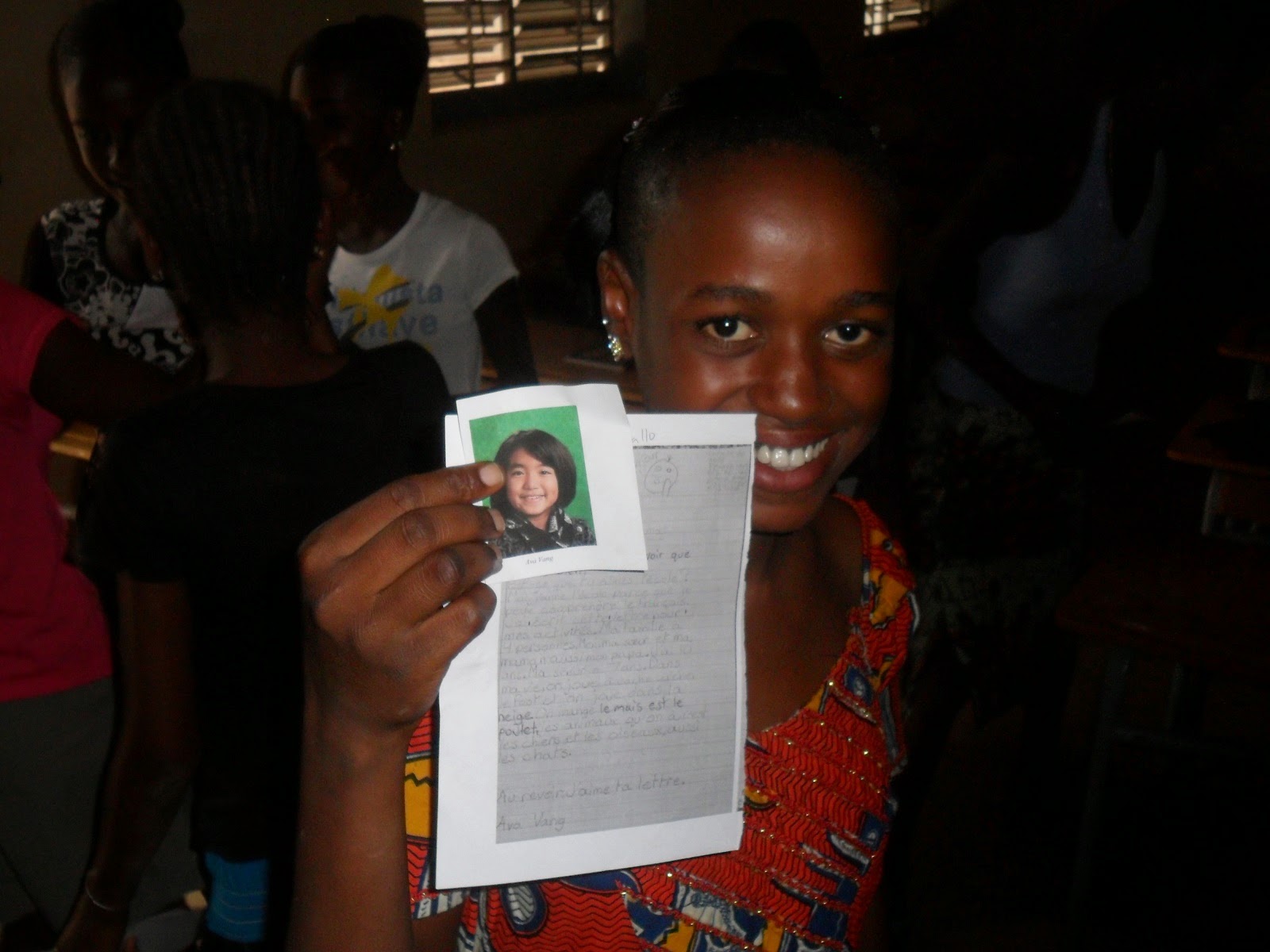
Meanwhile, a few kilometers away, I delivered the next batch of Pen Pal letters to the students of Teyel.  The students read their letters aloud, laughing excitedly, then passed them around to their friends and immediately began drafting their responses.  If everything goes as planned, I'll be able to deliver the next letters from Teyel to St. Paul when I go home on vacation in a couple weeks.